Philip H. Wiebe on “What Norms or Values Define Excellent Philosophy of Religion?”

Philip H. Wiebe is Professor of Philosophy at Trinity Western University, Canada. We invited him to answer the question “What norms or values define excellent philosophy of religion? as part of our “Philosophers of Religion on Philosophy of Religion” series.

With a growing understanding of the importance of theories that postulate the existence of unobservable objects in science, and the (near-) demise of positivism half-way through the 20th century, recognition of Principles that have a bearing on the evidence for theories has grown. If religion is construed to postulate the existence of spirits (cf. Daniel Pals, Seven Theories of Religion, OUP 1996), which are more-or-less unobservable minds, it can benefit from a survey of the Principles that guide science. The following are readily found in philosophical discussions of science:

A. Principle of Positive Instances: A hypothesis is supported by its positive instances, e.g. ‘All ravens are black’ is supported by the observation of black ravens.

B. Special Consequence Condition: If evidence E confirms (increases the firmness of) a hypothesis H, and ‘H’ → ‘I’, then E confirms I.

C. Converse Consequence Condition: If evidence E confirms (increases the firmness of) a hypothesis H, and ‘K’ → ‘H’, then E confirms K.

D. Confirming Evidence Principle: If evidence E confirms (increases the firmness of) a hypothesis H, then Prob (H,E) > Prob (H).

E. Entailment Condition: If ‘E’ → ‘H’ then E confirms (increases the firmness of) H.

F. Assessment of Probabilities: The axioms of the probability calculus offer methods by which probability values can be determined, estimated, or conditionalized. Not all interpretations satisfy the calculus:

a. Relative Frequency: e.g., Probability of purchasing defective tires
b. Equiprobable Case: e.g., Probabilities re throwing dice
c. Subjective: e.g., “Gut feeling” re some future event
d. Personal: Forcing subjective probability values to conform to the Probability Calculus (Axioms & Theorems derived therefrom) or some other factors deemed rational
e. Logical: Prob (H,E) is the evidential support of evidence E on hypothesis H
f. Propensity: Physical tendencies of one thing to cause another, e.g., propensity of dynamite explosions to produce avalanches

G. Principle of Classical Empiricism: Data items consist minimally of sense perception, memories, feelings and other states of supposedly “immediate” awareness.

H. Division of Evidence: Evidence can be classified as (i) Experimental, (ii) Semi-experimental, and (iii) Anecdotal.

I. Semi-experimental evidence: If the amount of semi-experimental evidence is large, it has significant evidential value.

J. Theory-laden Data: All data items are set within a framework (paradigm, worldview, conceptual scheme) in which certain theories about the nature of the world are already presupposed.

K. Principle of Credulity: The way things appear are probably the way they are, unless we have reason to question this.

L. Principle of Testimony: Reports from those who claim to have directly experienced something ought to be accepted, unless we have reason to question these reports.

M. Principle of Cumulative Effect: The cumulative effect of separate items of evidence confirming of a hypothesis, is greater than the mere sum of these individual items.

N. Extreme Illuminates Obscure: Examining an extreme phenomenon can illuminate cases in which that phenomenon also occurs, but in more obscure form.

O. Principle of Simplicity: A hypothesis that is simpler than another is more likely to be true.

P. Principle of Naturalism: Natural explanations should first be sought for phenomena, before considering any supernatural one.

Q. Principle of Modest Hypotheses: When attempting to explain a phenomenon, it is more plausible to form a hypothesis with respect to a smaller reference class than a larger one. E.g., when we discover that a thing of a certain shape, size, build, etc. has a certain color, it is more plausible to conjecture that all things of that shape, size, build, etc. have that color than that all things have that color.

R. Comparative Falsifiability: Theory T is preferable to theory S if T is more falsifiable than S (perhaps because T has more content than S)

S. Explanatory Power: A theory T that provides a single explanation for diverse phenomena is more plausible than a theory S that provides a single explanation for fewer of the phenomena that T explains.

T. Clarity and Precision: A theory T that is more precise or clearer than a competitor theory S is more plausible than S

U. Ad hoc hypotheses: Hypotheses that are advanced only to accord with known data are less plausible than hypotheses that have considerable import beyond the data already in hand.

V. Comparative Plausibility: A paradigm that prevails in the completion of paradigms is rendered more plausible by doing so.

I offer the following observations concerning these Principles and their possible applicability to religion:

1. These Principles are central to an empirical epistemology, and speak to (a) descriptions of phenomena, (b) theories advanced to explain phenomena, and (c) paradigms (conceptual schemes) within which descriptions and theories are found.

2. More Principles than these could be found. No way of limiting their number seems feasible. They appear to be obtained in much the same way that theories are, and are both confirmable and falsifiable. They are constraints on rationality, not its formal definition.

3. Some proponents of religion make much of the paradigm featured in it, and add that paradigms are not testable in the way that theories are. This seems flawed, for paradigms in science have given way to evidence just as theories have; also, this view removes religion from criticism, and encourages the imposition of a religious paradigm on data.

4. We cannot say that every critical inquiry embraces all of these Principles, e.g., the theory postulating the Higgs-Boson particle was confirmed, but was (arguably) not falsifiable. Comparable expectations are appropriate for religion.

5. Identical subsets of these Principles will not be found in every critical inquiry, e.g., Ernst Mayr argues for a distinction between functional biology and historical biology, and holds that biology differs methodologically from physics (“The Autonomy of Biology,” Quart. Rev. Biol. 1996).

6. The empirical epistemology I am sketching here (cf. my God and Other Spirits, OUP 2004) cannot be applied to a Being whose attributes are infinite, for no empirical distinction between a very large powers and an infinite power is determinable. Such a Being might exist and interact in the cosmos, however.

7. A detailed study of religion would reveal the plausible (and implausible) Principles adopted in it; this work has hardly begun.


Leslie A. Muray on “What Norms or Values Define Excellent Philosophy of Religion?”

Leslie A. Muray is Professor of Philosophy and Religion at Curry College. We invited him to answer the question “What norms or values define excellent philosophy of religion? as part of our “Philosophers of Religion on Philosophy of Religion” series.

When asked “What are the norms or values that define excellent philosophy of religion,” I think of Whitehead’s norms for judging the excellence of metaphysics. These are: 1. a worldview that is consistent; 2. coherent; and 3. and adequate to the facts of experience. In other words, it will present a comprehensive (but not totalizing) worldview in which “everything hangs together,” in which there are no contradictions.

As far as “religion” in “philosophy of religion” is concerned, true to its etymological roots, the words imply a comprehensive vision of reality in which the parts are not swallowed up but affirmed, in which “the many become one, and are increased by one.” With this kind of emphasis in Western thought, it is easy to see why excellence in “philosophy of religion” has been described with words like “simplicity” and “elegance.” Both of these words, and others like them, are descriptive of philosophical excellence in rational argumentation and systematic thinking.

Thus, if one reads a classic philosophical text from continental philosophy, one would read a meticulously translated, rigorously thought out argument, with positions rebutted and the rebuttal wrestled with and/or rejected. Each topic follows logically from the preceding topic. Whatever school of thought a philosopher belongs to, this is the pattern. They are inviting us into a neatly ordered word.

But what if the world, including the world of the philosophers, is not like that? What if philosophers of religion see their task with greater humility, drawing conclusions with great tentativeness? I am thinking of the ways in which process thinkers Bernard M. Loomer and Bernard E. Meland opted for a more radically empirical version of process than the influential rationalistic one of Charles Hartshorne (Meland in fact was called “a rebel among process theologians).” Meland tirelessly reminded his audiences that “we live more deeply than we can think.”

The kind of philosopher I am thinking of may very well write the kind of rationalistic, scholarly philosophical tracts described above. But there is another kind of writing, sometimes by the same authors (Bergson, Berdyaev, Dewey) who write less specialized, more popular pieces. What they contribute to philosophy is no less important to the norms of excellence of philosophy of religion. A quick example is provided by Whitehead’s The Aims of Education. The three stages of education are romance, precision, and generalization. Precision and generalization are the sorts of philosophical norms we expect-but there is more: romance! There is an emotional tone to all learning, to all life!

I think we have all read works, including by our favorite authors’ that are not well thought out, not well organized-yet they contain gems of insight that one can spend a lifetime looking for and not find. Although I think we can find this with virtually every thinker, I am thinking especially of Bergson and Berdyaev. For Bergson, intuition is the primary way we know things. It can be a motivating factor in other modes of knowledge. It may seem to give incomplete answers. Bergson’s works were condemned by the Roman Catholic Church for “irrationalism.” Berdyaev would get exasperated with people who chided him for his seeming lack of consistency and unremittent emphasis on intuition and creativity. Hartshorne has described his motto as being, “Be creative and foster creativity in others!” Thus, there are elements that go into the making of excellent philosophy of religion, even if seemingly underdeveloped: intuition, insight, creativity. Without these philosophy of any kind does not flourish.

I would like to tell a story that is pertinent to the position espoused here. More than twenty years ago, I was attending a Buddhist-Christian Dialogue which coincided with an Episcopal Chaplains’ meeting at Purdue University. One night at dinner, some of my fellow chaplains and I sat at a table next to which sat three luminaries of the theological world. Langdon Gilkey, Hans Kung, and David Tracy. I overhead David Tracy saying, “If the unexamined life is not worth living, the unlived life is not worth examining.”

J. Aaron Simmons on “What Norms or Values Define Excellent Philosophy of Religion?”

J. Aaron Simmons is Associate Professor of Philosophy at Furman University. We invited him to answer the question “What norms or values define excellent philosophy of religion?” as part of our “Philosophers of Religion on Philosophy of Religion” series.
What norms or values define excellent philosophy of religion?

I have described my own approach to philosophy of religion as “mashup philosophy of religion” because I think that there is virtue in drawing broadly on different philosophical traditions, religious perspectives, and disciplinary methodologies.

Personally, I am deeply influenced by continental trajectories in philosophical inquiry, but I often resist the characterization of my work as “continental philosophy of religion” because such a description too often allows for fundamentally different (and largely opposed) norms to be operative in different types of philosophy of religion. Rather than understanding these different approaches as metaphorical streams all feeding into a larger river, what one too often finds are seemingly different bodies of water altogether and each claiming to be the best, or only, river in the watershed. I find this to be unfortunate and amounts to a missed opportunity for robust engagement with others who think about similar questions from different perspectives. That we might come down differently from our interlocutors does not necessarily mean that we are engaging in a different sort of philosophy (though that might be the case), but that we disagree about where the arguments lead us as philosophers.

Despite my deep commitment to such pluralistic “mashup” work, I do think that philosophy of religion must remain self-consciously philosophical, as opposed to claiming theological authority, on the one hand, or attempting simply to provide poetic inspiration, on the other hand. As far as I am concerned, far too much of contemporary analytic philosophy of religion slides too easily into confessional theology, and far too much of contemporary continental philosophy of religion becomes not much more than imaginative creative writing. Although there is significant value in both theology and also in creative writing, neither should be understood as easily interchangeable with philosophy of religion.

Without question, philosophy of religion should be in conversation with a variety of texts (those that claim revealed authority within a particular community as well as those that aim to inspire particular forms of life are both quite valid resources), but philosophy, whether understood as a way of life or as a professional discourse, should be devoted ultimately to offering sound arguments supported by evidence. Such evidence should be, in principle, available to all members of the philosophical community in order for that community to have appropriately functional (even if porous and contingent) boundaries. So, whereas “analytic” theology, say, sometimes seems problematically to limit the community to whom it is speaking to those philosophers already agreed about basic matters of religious existence, “radical” continental theology sometimes seems equally problematically to replace argumentation with rhetorical flourish.

Warning against such tendencies, however, should not amount to a radical rejection of the discourses in which they occur. Hopefully philosophy of religion can appropriate what is right about both theology and also poetics without forgetting its own historical identity as philosophy. Namely, like theology and poetic writing, philosophy of religion should be personally compelling by speaking to where we find ourselves as finite beings trying to find meaning in a complex world.

Theology impressively fosters personal investment, for example, by cultivating a profound sense of humility in relation that which is variously termed “the transcendent,” “the divine,” or “God.” As such, our lived existence is perhaps at stake in theology in a way that is not often true for philosophy of religion due to its frequent attempt to be detached, objective, or neutral. Rather than reminding us of our humanity, such objectivist gestures can sometimes serve to separate us as inquirers from ourselves as existing individuals. Alternatively, creative poetic writing fosters existential awareness, perhaps, by reminding us that existence is never reducible to the conclusion of an argument regarding the content of the good life.

Excellent philosophy of religion understands that arguments matter, but always remembers that such arguments always only matter for someone, somewhere, and for some reason. Like poets and theologians, philosophers are people too!

Theology and poetry, thus, both give concrete expression to the idea that we are beings made for more than symbolic logic-but this very point is something for which philosophers can provide very good arguments. Borrowing slightly from Heidegger, we might say while poetics realizes that we should sing and dance before God, theology understands that it is probably a good idea not just to sing and dance before anything whatsoever. Accordingly, philosophers of religion should care about holding true beliefs about traditionally religious concepts, but also about taking seriously the lived human condition that serves as the existential context in which philosophers find themselves seeking such truth.

So, as a matter of professional identity, how can excellent philosophy of religion strike this balance of being appropriately personal without being narrowly confessional, on the one hand, while being existentially vibrant without abandoning argumentative rigor, on the other hand? Asked slightly more phenomenologically, how can philosophy of religion be “objective” enough to remain a proper academic discipline while also being “subjective” enough to speak to the all-too-human search for meaning, value, and truth? Or, asked as a question about academic disciplines, how can philosophy of religion remain a thoroughly humanistic discourse while also being able to speak with and to the social and natural sciences?

As just a first step toward thinking through these questions, let me recommend two concrete practices in particular that I think are likely to help philosophy of religion to strike such complicated balancing acts.

First, in order to maintain the “objective” traits that ought to characterize academic discourse, broadly construed, philosophy of religion should more self-consciously appreciate the diversity of global religious traditions by drawing deeply on the work done in the academic study of religion. Attending to such work helps to overcome the temptation to think that religion is exclusively, or even primarily, a matter of correct belief. Moreover, by looking to the historical practices of those cultural movements categorized as “religious,” philosophers can overcome the suspicion that philosophy of religion is just disguised theology by becoming a critical conversation partner with the social sciences. Learning from sociology of religion, history of religion, and comparative religious studies, for example, philosophy of religion can remain committed to argumentation as its primary mode of humanistic engagement, but now with a much more expanded social data set from which such arguments might proceed.

Second, the “subjective” aspects of philosophy of religion can be helpfully reinforced when philosophers attend more openly to the conceptual difficulties of the category of “religion” itself. Personal investment is philosophy of religion can be productively invited when individuals see themselves at stake in the arguments being offered. To that end, there is a lot for philosophers of religion to learn from those working in critical theories of religion. The basic terms of our discourse, ‘God’, ‘divine,’ ‘faith’, ‘salvation’, etc., are themselves products of very particular social histories in which our own identities are formed, shaped, and constantly renegotiated. Far from placing the category of “religion” at arm’s length from our lives, philosophy of religion should engage what we call “religion” as an historical phenomenon that invites our intimacy, trust, and investment. In this way, philosophy of religion can, itself, serve as something of a corrective to the objectivist tendencies that so often characterize the academy as defined by STEM priorities.

Philosophy of religion should not seek to eliminate theology or poetics. Similarly, philosophy of religion should engage the sciences without abandoning its own identity and humanistic values. Ultimately, philosophy of religion maximally displays an excellence all its own when it navigates the space between these different areas of human expression without simply becoming merely a subsidiary of any of them.

Gregory Dawes on “What Norms or Values Define Excellent Philosophy of Religion?”

Gregory Dawes is Professor of Philosophy and Religion at University of Otago in New Zealand. We invited him to answer the question “What norms or values define excellent philosophy of religion?” as part of our “Philosophers of Religion on Philosophy of Religion” series.

What norms or values characterize top-rate philosophy of religion? The most important norm with which such philosophy ought to comply is that of being wissenschaftlich, ‘scientific’ in the broad sense of that German term.
I do not mean that the philosophy of religion should follow some scientific method. Philosophy may well be, as Quine thought, continuous with the sciences. But it does not seem to have a distinctive method, or set of methods, as the sciences have distinctive methods. There is no procedure, no algorithm, that would allow one to formulate and test a philosophical claim. There are, of course, styles of argument and discussion in philosophy. But these are both diverse and contested. Think, for example, of the very different styles employed in what are (misleadingly) called the ‘analytic’ and ‘continental’ traditions. Analytic philosophers do not normally do philosophy by writing novels or plays, as did Jean-Paul Sartre, and are inclined to find a ‘literary’ style of philosophy irritating. Even if Jacques Derrida’s conclusions resemble those of Quine, or Davidson, or Kripke’s Wittgenstein, many analytic philosophers believe he is not doing philosophy ‘in the right way’. But if we abstain from such judgements and accept that all these people are philosophers, it looks as though there is no philosophical method, or agreed set of methods.

So I am not claiming that the philosophy of religion ought to be scientific in this sense. What I am claiming is that it ought to be scientific in the sense of being both detached from and critical of its object of study. Its object of study is, of course, religion. Definitions of religion are as diverse as are methods in philosophy. But a distinctive characteristic of religions is that they hold certain practices, beliefs, persons, or institutions to be sacred. To be sacred is to have a normative significance that arises from an other-than-human origin. If religions regard certain practices, beliefs, persons, or institutions as action-guiding, it is not because of any arguments that can be offered in their support. It is because devotees regard them as revealed by the gods, or willed by the ancestors, or arising from an individual’s contact with a non-natural realm, one inaccessible to everyday methods of perception.

The philosophy of religion, however, cannot regard any beliefs as sacred, in this sense. Our object of study will certainly be beliefs that are considered sacred by various communities. But philosophers must renounce the religious claim to an other-than-human source of knowledge. As even medieval thinkers recognized, the task of philosophy is to study ‘natural things naturally’ and the philosophy of religion must regard religion as yet another natural phenomenon.

This does not mean we must regard religious beliefs as false. After all, the sciences are also natural phenomena, and yet most of us would regard at least some scientific claims as worthy of belief. And even if prophets and shamans mistakenly believe themselves to be inspired by God or in contact with a supernatural realm, they could still be delivering messages that are true. The human mind operates in ways of which we are often unaware and can arrive at insights that appear to come from without. (The moments of ‘inspiration’ enjoyed by poets, musicians, and yes, even scientists, can be of this kind.) But if we believe what the prophet or shaman tells us, it is not because of his claim to divine inspiration. It is because his words have survived testing by methods we know to be independently reliable. They have proven themselves to be worthy of belief in ways that are independent of their claimed origin.

One might think that all this should go without saying. In all other areas of knowledge a broadly ‘naturalistic’ stance of this kind is simply taken for granted. Scientists may experience moments of what feels like inspiration, but they recognize that their insights must then be proven, in ways that are accessible to all competent observers. Why it is necessary to say this when it comes to religion?

It is necessary because the philosophy of religion continues to fall short of this norm. Its all-but-exclusive focus on Christian theism betrays a widespread assumption that if there is any truth to be found in religion, it will be found within this particular form of religion. While this assumption could, of course, be true – Christianity may be the only form of religion worth taking seriously – it remains an assumption. It is rarely supported by evidence or argument. My suggestion is that it is not, in fact, based on evidence or argument, but on the religious commitments of those philosophers who have shaped, and continue to dominate, the field.

Worse still, a recent trend within the field is to try to make the religious claim to an other-than-human source of knowledge philosophically respectable. The ‘Reformed Epistemology’ of Alvin Plantinga is the most striking example. If it were taken seriously (and there is, to my mind, no reason to do so), it would allow Christian philosophers to claim they are in possession of knowledge that comes from God, by way of what John Calvin called ‘the internal testimony of the Holy Spirit’. This is indeed what many Christians believe. They ‘know’ (that is to say, believe they know) certain propositions to be true because God has told them they are true. Such a claim can certainly be the object of philosophical scrutiny, which would quickly show it to be question-begging or vacuous. But it can never be the basis of a philosophical argument.

Until such claims are renounced, the philosophy of religion will never be truly wissenschaftlich. It will continue to be a quasi-religious exercise that non-believers will feel little need to engage with. To be truly wissenschaftlich will mean regarding all religious claims as worthy of study. As a philosopher of religion I should regard no form of religiosity as alien to me. I should regard the Yoruba religion of West Africa as worthy of study no less than Christianity or Islam. But (as Benjamin Jowett wrote about the Bible), I will assess them all by ‘the same rules of evidence and the same canons of criticism’, rejecting any claim they make to be of an other-than-human origin.

David E. Schrader on “What Norms or Values Define Excellent Philosophy of Religion?”

David Schrader taught philosophy of religion for thirty-one years at Loras College (Dubuque, IA), Austin College (Sherman, TX), and Washington and Jefferson College (Washington, PA). He also served as Executive Director of the American Philosophical Association from 2006-2012. We invited him to answer the question “What norms or values define excellent philosophy of religion?” as part of our “Philosophers of Religion on Philosophy of Religion” series.

In 1983 I wrote an article entitled, “Karl Popper as a Point of Departure for a Philosophy of Theology.”1 While I am certainly less enamored of Popper’s general philosophy of science than I was in 1983, there is one point that I raised in that paper that I continue to believe is crucial for philosophy of religion. In Conjectures and Refutations Popper notes that a “theory is comprehensible and reasonable only in its relation to a given problem situation, and it can be rationally discussed only by discussing this relation.”2

To answer the question of what norms or values define excellent philosophy of religion requires that we initially understand what kind of discipline philosophy of religion is. It is not theology, not even philosophical theology. It is a philosophical discipline. Moreover, it is a “philosophy of …” discipline. This means that the first virtue of philosophy of religion is that it be scrupulously attentive and honest in its attention to actual religion.

There was a time not that long ago when much of philosophy of science was practiced as a kind of idealized epistemology, with little attention to the actual practice of science. While there is much to criticize in the work of Thomas Kuhn, philosophers of science owe him a great debt for pushing them to take seriously the history and actual practice of science, even as they may need to do it much more carefully than Kuhn himself did. There are similar stories to be told about philosophy of language, philosophy of art, and a number of other “philosophy of …” disciplines.

The above reflections lead me to identify two norms that are essential to excellent philosophy of religion. First, the philosopher of religion must start with a view of the point of religion, and as a corollary, the “problem situations” to which theologies are productively addressed. Second, the philosopher of religion must have a relatively broad understanding of the phenomenon of religion. It is not sufficient to do technically sophisticated analyses of isolated doctrinal statements.

On the first point, religions historically have been about at least two different sets of concerns. On the one hand, some historical religious traditions have been centrally concerned to either control or explain natural phenomena. On the other hand, some religious traditions have been centrally concerned to understand moral phenomena. For a number of reasons, not the least of which I’m sure is my immersion in the Lutheran Christian tradition, I believe that the latter, but not the former set of concerns provides a conception of religion that is sustainable in the contemporary world. For myself, if I saw religious belief only as an attempt to explain why there is anything rather than nothing, or why there is intelligent life in the universe, I would almost certainly find no place for religion in my life. I fear, however, that contemporary philosophers of religion too often accept this understanding of religion without even considering that it might not be the only way of viewing religion.

The second view of religion, however, is surely not without its advocates. On Luther’s view, for example, “[t]heology is … concerned neither with an objective doctrine of God nor with an anthropology that asks questions about man other than those involving his relationship to God. Both sides of this relationship are determined by the fact that man is a guilty and lost sinner and that God is the justifier and the redeemer of precisely this kind of man.”3 This essentially moral understanding of the point of religion is largely affirmed in the philosophy of religion of Kant. More recently, it has been elaborated in a pair of books by Ronald M. Green: Religious Reason: The Rational and Moral Basis of Religious Belief (New York: Oxford University Press, 1978) and Religion and Moral Reason: A New Method for Comparative Study (New York: Oxford University Press, 1988).

Whether I am right or wrong in my commitment to this latter view, I believe that work in philosophy of religion cannot be excellent without attending to this issue of the point of religion.

On my second and final point, philosophy of religion will fail to be excellent to the extent that philosophers of religion take their own expressions of religion to tell the whole story of religion. I remember a number of years ago at a Society for Philosophy of Religion meeting, when a presenter, who clearly came from an Anglo-American evangelical protestant tradition, responded to a traditionally Aristotelian Catholic understanding of the religious implications of Darwinian evolution with the claim that it was “ad hoc,” failing to understand that it was much more “traditionally” Christian than his own view. My own understanding of my Christian belief has been importantly shaped by my study of the understanding of language of the Buddhist scholar, Nagarjuna (ca.150 – ca.250 C.E.), an understanding not altogether unlike William James’s understanding of language.

Again, it seems to me that too many contemporary philosophers of religion accept uncritically a kind of Augustinian understanding of language that facilitates technically sophisticated analyses of isolated doctrinal statements but leaves little room for mystery in faith and has little contact with lived religion. If we really believe that our language is capable of giving an accurate representation of God, then it seems to me that we are guilty of a form of conceptual idolatry, worshiping something of our own intellectual construction, something far lesser than God. I conclude by looking back to my 15-year old self. In my Lutheran confirmation classes we learned that we Lutherans believed the doctrine of consubstantiation, by contrast with our Catholic friends who believed the doctrine of transubstantiation and our Reformed friends who believed that the Eucharist was a merely symbolic ritual. Of course I didn’t understand what any of those terms meant. I started to gain some understanding of them only when I first studied Aristotle’s metaphysics in college. Now, should we say that meant that I didn’t really believe those things? I doubt it. The Lutheran doctrine of consubstantiation, even though I didn’t “understand” it, clearly underlay important aspects of my religious practice.

Whether I am right or wrong in this latter claim, it seems to me that philosophy of religion cannot be excellent without at least considering the issue.

Jeppe Sinding Jensen on “What Norms or Values Define Excellent Philosophy of Religion?”

Jeppe Sinding Jensen is Associate Professor in the Department for the Study of Religion at Aarhus University. We invited him to answer the question “What norms or values define excellent philosophy of religion?” as part of our “Philosophers of Religion on Philosophy of Religion” series.

The question of “What Norms or Values Define Excellent Philosophy of Religion?” really is simple to answer. They cannot be anything other than the same norms and values that underwrite all other academic – philosophical and scientific – pursuits. What else, might we ask, if they are to be housed in the modern university? The problem for the philosophy of religion rather lies, as other blogposts indicate, in the distinction of the object of the ‘of’-relation. What is it that the philosophy of religion is a philosophy ‘of’? Norms and values display and relate degrees of rightness or wrongness in relation to human practices in accordance with given cultural and historically contingent social conventions. However, in the academic world, certain universal and transcendent conditions rule: truth, rightness and honesty must reign. Here, the least one can do is to secure an appropriate coverage of terminology. Thus, the crucial point is what is meant by ‘religion’ – as the meaning of ‘philosophy’ must follow the general usage in and of the modern university. Unfortunately, for the clarity of the discussion, ‘religion’ is a term that covers a fuzzy, if not outright messy, set of concepts. The philosophy of religion, if there is to be one such, must then necessarily follow the usages and insights from the study of religion, studies of religion that must, it should be pointed out, remain and rely on the same epistemic levels and with the same ontological commitments as philosophy in general.

‘What is religion?’ becomes the principal question, then. The many aspects of what we habitually cover by the concept of religion would preclude any stable treatment of the issue. The philosophy of ‘religion’ would necessarily dissolve into philosophies of sociality, semantics, beliefs, emotions, behavior, power, politics and the many other things that may be included in any religious tradition. Looking towards established philosophy of religion, we have been accustomed to what Mark Gardiner recently noted as philosophical reflections on ‘a particular type of belief system, namely Eurocentric abstract monotheism.’ I agree with Gardiner, that with ‘belief’ as the privileged core, the philosophy of religion has been narrow and skewed. Granted, there is a problem (or more) with the rationality of religious belief in the modern world, but that certainly is not the only – nor need it be the dominant – question for a responsible philosophy of religion. Imagine, what would the subject matters be of a hypothetical philosophy of TV? If it focused narrowly on advertising income, or on news presenter hairstyles, important as they may be in some places, we would instantly recognize the missing bits and pieces. Thus, to be brief, I must admit that I can see no other avenue for the philosophy of religion than to develop a broader conception of its own role in the modern university. Just as philosophers of, say, language have the work of linguists and other scholars / scientists as setting the boundary condition for their philosophy of language, so philosophy of religion should be congruent with the study of religion in its fundamental assumptions. This would mean listening to what goes on in the study of religion. However, not everything that goes on in the study of religion need be equally important, or even worth contemplating for philosophers, but many things will be worthy of attention. Here, it is equally notable how the study of religion seems to thrive in the university without serious engagement with philosophical questions. If, and when, practitioners of the study of religion may seem to neglect or disregard philosophical issues and tasks, it may also be because the impressions they get of what philosophy is and does have come from conventional philosophies of religion that appear parochial and one-sided. Contemporary studies of religion stress many aspects other than those relating to truth-issues in religious discourse. Such aspects are the emotional, behavioral, ritual, institutional – to name but some. It follows that the philosophy of religion should be oriented towards those same aspects and be able to assist the scholarly community in clarifying and explaining what philosophical engagements with religion and the study of ‘it’ may contribute to our understanding of these aspects of the human condition. This is what we should and could do. As can be seen from the number of subjunctives here, this little piece is a contribution to a normative discussion, true, but please note that it is a contribution to a discussion of methodological normativity. Thus, the philosophy of religion should not be a contribution to religion, but to philosophy on the one hand and to an understanding of religion on the other. Consequently, the register of normativity must shift from the moral-existential (or outright religious) to the methodological. The first requirement, then, is the distinction of what the philosophy of religion is a philosophy of. If its object is that which we call ‘religion’, then the philosophy of religion would need to heed what goes on in the humanities, in the social and the life sciences in due proportions and take its course according to its current object of reflection or investigation. The philosophy of religion must be nested within philosophies of other and ‘greater’ matters, just like an imagined ‘philosophy of ornithology’ would be embedded in a philosophy of biology in general.

Sonia Sikka on “What Norms or Values Define Excellent Philosophy of Religion?”

Sonia Sikka is Professor of Philosophy at the University of Ottawa, Canada. We invited her to answer the question “What norms or values define excellent philosophy of religion?” as part of our “Philosophers of Religion on Philosophy of Religion” series.

Objectivity as an intellectual virtue in the Philosophy of Religion

The virtue of objectivity, understood simply (and vaguely) as an impartial willingness to follow the evidence where it leads, is surely of obvious value for any and every sphere of inquiry. A hermeneutics of suspicion might raise doubts about the possibility of actually achieving such a stance, and of course there are vexing philosophical questions about the nature of truth. But the sense that holding oneself to the regulative ideal of objectivity is an essential prerequisite for arriving at the truth, should it be possible to do so, is fundamental to the self-conception of philosophy, and it is a virtue in which philosophers generally take pride. Bertrand Russell speaks of “the impartiality which, in contemplation, is the unalloyed desire for truth,” connecting this “quality of mind” with justice. Heidegger, whose philosophical methodology otherwise has little in common with Russell’s, expresses a similar sentiment when he argues that a “Christian philosophy” is a contradiction in terms because philosophy is essential questioning. It asks, “why is there something rather than nothing?” whereas for faith, the question is already answered. Nietzsche may be alone among philosophers in questioning the value of an objective pursuit of truth, but even he does not maintain this stance consistently. It is hard to mistake the note of pride in his suggestion that, while complete knowledge may destroy a person, “the strength of a spirit” should be measured by “how much truth he can endure,” or how much he needs to have that truth diluted, sweetened and falsified.

Religion is especially, for Nietzsche, the expression of weak spirits who cannot take the truth. This idea that religion is an error produced and sustained by desire – an “illusion” in Freud’s sense of that term – is by now a commonplace in both popular and academic discourses. Fear of meaninglessness and especially of death is often taken to be the ultimate explanation for religious projections, echoing Feuerbach’s proposal that “the grave of man is the birthplace of the gods.” One should be careful, though, of committing what I have taken to calling the nihilistic fallacy, supposing that if a belief is disconsoling, it is ipso facto true. This subtle bias is typical of a certain modern attitude, whose rhetoric often betrays pride in one’s own capacity to endure the cold, hard truth whereas weaker spirits must cling to comforting illusions. It sometimes informs discourse favoring “naturalism,” as opposed to belief in the “supernatural,” something of which no self-respecting, scientifically-minded and rigorous, philosopher wants to be accused (though a genuinely rigorous analysis needs to pose hard questions, I feel, about the meanings of interdependent terms such as “natural” and “supernatural”).

Yet, with this caveat, philosophy should be essential questioning rather than confessional apologetics, and there are credible concerns about whether the current shape of the philosophy of religion truly is that. The dominant topics and structure of this subfield tend to reveal its origins as a descendent of Christian theology, continuing to follow the model of “faith seeking understanding,” Anselm’s motto in a distant age. John Schellenberg has pointed to the dominance of conservative Christian theologians within the field, suggesting that their approach is often not philosophy at all but Christian apologetics using the tools of philosophy. To be sure, one cannot legitimately dismiss arguments merely because they are presented by someone who happens to be a believer. It would also be naïve to suppose that anyone who enters a philosophical debate on a topic they care about is ever entirely neutral towards possible conclusions. We all have our sympathies. But starting with a bundle of “truths” that one is committed to defending no matter what hardly represents the virtue of objectivity, and seems an untrustworthy route for arriving at the most plausible beliefs about ultimate reality, death, or evil, among the other issues with which the philosophy of religion typically engages. If one should not overestimate the difference, in practice, between faith seeking understanding and open-ended philosophical questioning, one should also not collapse it.

Personally, I have found the practice of teaching philosophy of religion to be the best education in objectivity. Trying year after year to perform the delicate balancing act of being respectful and kind to students coming from an enormous variety of perspectives, while at the same time encouraging thoughtful and critical reflection, provides a rare exercise in seeing, not without interest but with many and different eyes (Nietzsche’s interpretation of the closest we can come to “objectivity”). To some extent, this is true of all teaching, but philosophy of religion is different. The subject evokes strong passions stemming from beliefs that are constitutive of people’s identities, from the extremes of devout faith to militant atheism, with individuals at opposite ends finding it pretty much equally painful (in my experience) to take counterarguments seriously. It is impossible not to be intellectually shaped by the practice of repeatedly negotiating this context, under the pedagogical self-discipline of holding to values that are in the first place actually social rather than epistemic. I want to promote civility while not being perceived as favoring any student or set of students over others. I want to present counter-arguments without setting myself up as an adversary or opponent. I want also, in this subject more than in others I teach, to be compassionate, given the depths of the feelings and sensitivities at stake. Whatever conclusions I may come to on metaphysical questions, I would never want to treat lightly the refusal of tragedy and longing for meaning that motivates many (though not all) religious beliefs.

No doubt perfect “objectivity” in a field like this one is unachievable, supposing that such an ideal is even intelligible. But if it is possible, in our classrooms, to consider with equal charity the views of believers and atheists and those in between – including thoughtful seekers trying to discover what is most plausible in a piecemeal fashion rather than committing themselves to one or another of those bundles of belief-and-practice that we call “religions” – then there is no reason why we cannot do the same in our scholarship.

Robert Nola on “What Norms or Values Define Excellent Philosophy of Religion?”

Robert Nola is Professor of Philosophy at University of Auckland, New Zealand. We invited him to answer the question “What norms or values define excellent philosophy of religion?” as part of our “Philosophers of Religion on Philosophy of Religion” series.

The question to be addressed is: “What norms or values define excellent philosophy of religion?” There are many distinct areas within philosophy which concern themselves with special ‘philosophy of X’ topics where X can be mathematics, science, history, social facts, morals, and the like. In so far as these are philosophies of …, they will all, hopefully, exemplify the same values and norms which apply to philosophy itself (whatever these be). But the question also raises the possibility as to whether there is, for some X, some particular values or norms which are dependent on the kind of X considered and which do not apply to some other philosophy of Y or philosophy of Z. So, are there some particular norms or values in the case of philosophy of religion which do not arise in the case of, say, philosophy of science, or mathematics?

Consider ontological matters. These arise when for example, we consider philosophy of mathematics and ask whether or not there exists mathematical entities such as numbers (to which mathematical Platonism answers ‘yes’, but constructivism and various kinds of anti-realist stance can be taken to say ‘no’). Again matters of epistemology arise when we ask what knowledge of mathematical entities we can have, given that we do not have immediate epistemic access to them. For the Platonist this is a problem, but for anti-realists this is not such a large problem since there are no such entities to which we need to have any epistemic access. Finally consider logical matters. Logic is at the core of philosophy and would be part of any philosophy of X that deserves to be called ‘philosophy of …’. If philosophy of religion were to ignore the values and norms of logic its viability would be undermined (as has often been the case).

Similarly in religion, entities like God or gods or souls or spirits are postulated and we need to know, within the philosophy of religion, what answer can be given to the ontological question about God’s existence and what answer can be given to matters concerning their epistemic access. For the theist these are problems, but for the atheist these problems do not arise. In fact faulty ontology or epistemology provides weapons for the critique of much philosophy of religion.

These considerations give support to the view that in philosophy of religion there are no special values and norms which apply to it but not any other philosophy of X. There may be distinctively important questions to pose and answer within philosophy of religion; but answering them ought to employ the values and norms found in ontology, epistemology, logic and other areas of philosophy.

For atheists (e.g., scientific materialists) ontological questions within the philosophy of religion have a negative answer; none of its postulated entities exist. Religion is a vast error theory (to employ a term of John Mackie). However atheists do agree that there are still important questions to address concerning religion. God does not exist but there is still the matter of accounting for why people have commonly believed that God (or gods) exists. Thus Hume in his 1757 The Natural History of Religion looks to the perilous existential conditions of human existence as a cause of human belief that God(s) exists; and he also adopts the view that God is some kind of projection onto the world. In his 1841 The Essence of Christianity Feuerbach is more explicitly projectionist. But the God we humans project onto the world as existing is to be understood non-realistically; God does not exist independently of our projection of him. In the 20th century an important Humean influence can be found in the work of the anthropologist Stewart Guthrie, who proposes, in his 1993 book Faces in the Clouds: ‘… religion may best be understood as systematic anthropomorphism: the attribution of human characteristics to non-human things or events’. This is a suggestive research programme which should accord with the norms and values of any empirically based science (but not necessarily religion or its philosophy). This is particularly so when the sciences of anthropology or sociology are applied to religion.

Hume’s posthumously published Dialogues Concerning Natural Religion largely considers arguments concerning the existence of God; he takes a dim view of their success (many in the philosophy of religion have yet to learn this from Hume). The Dialogues are often taken to be paradigm cases of good, critical, philosophical arguments applied to problems within the philosophy of religion. Addressing matters of argument has continued within 20th century philosophy of religion. If philosophy of religion is to survive as a subject it must employ the best resources of contemporary forms of reasoning developed within philosophy such as inference to the best explanation, probabilistic reasoning, decision theory, and the like.

But alongside this, the last 50 years or so has seen a rapid growth in scientific studies of religion which bypass the traditional approach to religion based upon philosophy. Their aim is to draw upon the values and norms of science (and not philosophy) in explaining matters, such as why people believe in gods, the neurological basis of “religious” experiences (such as near-death experiences, or out-of-body experiences), the nature of spirituality, a naturalistic approach to Godless morality, and the like. These studies can be seen as complementing our understanding of religion and the problems traditionally addressed in philosophy of religion. But they can also be seen as undermining and debunking much of religion and its accompanying philosophy. It debunks because it exposes as erroneous many traditional explanatory accounts of religion which appeal to a divine God. In so doing it proposes a rival naturalistic account of how religious beliefs come about which then replaces traditional religion and its philosophy.

Earlier in the 20th century Freud, a committed atheist, proposed that the causes of religious belief were to be found in “psychiatric delusions” such as unfulfilled wishes for a providential “father” figure to guide us through the vicissitudes of adult life. Freud took himself to be giving a scientific account of aspects of religion – but of course his psychological hypothesis needs to be subject to test by the methods of science. Freud is also a debunker of religion who took a dim view of the attempts by advocates of the philosophy of religion to maintain religion in some way; they ‘try to defend it piece by piece in a series of pitiful rear-guard actions’ (Civilization and its Discontents Part II).

Perhaps one of the strongest challenges to traditional philosophy of religion comes from the account of religious belief to be found within the theory of evolution. Darwin had suggested in his The Descent of Man that there is a general propensity for humans to attribute agency to ordinary happenings (like storms, volcanic activity, etc) and that this readily passes into a belief in God or gods as unseen agents. This has served as a basis for recent theorizing within cognitive psychology about the evolution of agent detection devices which were initially directed upon the predatory agents with which our ancestors had to cope in order to survive. So there is postulated to be, in our minds, a hypersensitive agency detection device, given the acronym ‘HADD’. The processes of evolution along with other cognitive developments (such as language use and story-telling), turns HADD into an important evolutionary by-product which acquires the new role of postulating agents quite generally, such agents being a God, or gods. Again the postulation of HADD is a matter which has been given much attention to determine its scientific credentials.

In addition there is research within the theory of evolution which is outside cognitive psychology. It looks, for example, at cooperation within social groups and the role which the belief in God(s) can play in maintaining and even enhancing societies. See for example, Dominic Johnson’s God is Watching You: How the Fear of God Makes us Human (2016) and Ara Norenzayan Big Gods: How Religion Transformed Cooperation and Conflict (2013). Once again belief in God is important; whether there is a God of traditional philosophy of religion drops out of consideration. The topics covered in these books are an important part of current research within the scientific study of religion.

All of these studies are part of a naturalized approach to religion in which religion is no longer taken at its face value, as in traditional philosophical approaches. Rather the studies are part of the extension of science to the field of religion (critics would dub this as being “scientistic”). Given the same length of time in which philosophy has been an accompaniment to religion (from the Ancient Greeks onwards), it will be interesting to see the challenges which science will bring to religion and how much of it will survive (in my view not much). As matters currently stand, many of the above hypotheses need to have a proper scientific basis in testing; without this they will fall by the wayside as merely historically interesting speculations. But it is in this way that a scientific basis for religious belief will emerge from the processes of scientific development and testing. Such a process of conjecture and refutation marks an important difference between religious and many philosophical approaches to belief in God and the scientific approach.

The original question asked was about the norms and values which apply to philosophy of religion. If it does not adopt the same standards to be found within philosophy then it is a lost subject, no better than dogmatic belief. However the consideration of religion from a philosophical viewpoint is very narrowly confined. The application of the norms and values of science opens up quite new perspectives on religion and the role it has played in human existence. For too long religion and its philosophy have escaped this kind of critical scrutiny. It is a moot question as to whether either will survive this scrutiny.

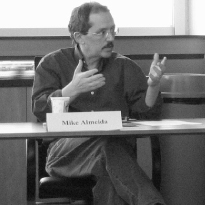
Michael Almeida on “What Norms or Values Define Excellent Philosophy of Religion?”

Michael Almeida is Professor of Philosophy and Classics at the University of Texas at San Antonio. We invited him to answer the question “What norms or values define excellent philosophy of religion?” as part of our “Philosophers of Religion on Philosophy of Religion” series.

Methods, Norms, and Values in Philosophy of Religion

Methodology in the philosophy of religion, with few exceptions, has not received much discussion.1 It is a common methodology—but not one that is especially self-conscious—to approach the broad range of issues that characterize philosophy of religion with what we might call vastly overconfident aprioricity. John Mackie illustrates this method. Mackie approaches the problem of evil with a striking degree of confidence in our a priori knowledge of the traditional attributes of God. He writes: ‘. . . in its simplest form the problem is this: God is omnipotent; God is wholly good; and yet evil exists. There seems to be some contradiction between these propositions, so that if any two of them were true the third would be false.’2 Perhaps as famously, Mackie boldly declares that ‘any adequate solution’ to his version of the problem of evil must abandon the proposition that God is omnipotent, or abandon the proposition that God is wholly good, or abandon the proposition that there exists evil. It’s out of the question for Mackie that, on the contrary, we might doubt his a priori intuitions about the concept of omnipotence or perfect goodness. It’s bizarrely regarded as out of the question to suggest that these intuitions might be mistaken or not especially well-informed. The idea that we might propose an alternative analysis of, say, omnipotence, Mackie relegates to the bin of fallacious solutions.

Mackie is not alone. We find a similar degree of confidence in J. Howard Sobel’s discussion of the problem of evil. Sobel considers the concept of omnipotence to be fully determinable a priori.

Rather than practice the doctrine of Humpty Dumpty on ‘omnipotence’ and ordinary synonyms of it such as ‘almightiness’, I have tried to call a spade a spade, and having done that to defend the possibility of ‘omnipotence’ naturally understood. Questions concerning omnipotence—what it comes to and whether it is possible—are properly prior to questions of God and omnipotence.3

Indeed, Sobel is critical of Plantinga’s departure from this straightforward apriori method.

Plantinga suggests that we may, without answers to the first general question about omnipotence, shift in reasonable hope of doing better to the second particular question of ‘God’s omnipotence.’ After finding difficulties with two definitions of omnipotence, he says: ‘But perhaps . . . even if we cannot give a general explanation of omnipotence, we may be able to say what God is omnipotent comes to.’ This methodology complicates matters and is strange.4

The approach of Mackie and Sobel is not uncommon among philosophers of religion—even if not everyone is as bold. The main problem with the excessively confident apriori method is that it simply ignores the phenomenon of ‘metaphysical surprise’. Surprising metaphysical facts—otherwise occluded facts—are typically revealed when we apply familiar concepts in unfamiliar contexts. It is an otherwise occluded metaphysical fact that moral perfection is consistent with not fulfilling every moral requirement. How could such a fact be revealed? Consider an essentially morally perfect being facing a necessary moral dilemma. Moral dilemmas—including necessary moral dilemmas—are such that, no matter what a moral agent does, she does something wrong. Such dilemmas arise in cases where, for instance, there is no best possible world, and they are structurally equivalent to rational dilemmas.5 A morally perfect being could find itself in a necessary moral dilemma.6

It is a similarly occluded metaphysical fact that omniscience is consistent with not knowing every true proposition. The fact is revealed in the unfamiliar context of an omniscient being facing indeterminate propositions—propositions that are true, but not definitely true. It’s of course an open question whether God could know indefinitely true propositions.7

To offer a few more examples, it is an otherwise occluded metaphysical fact that—contrary to almost every version of the cosmological argument—there is no observational evidence that there are any contingent explananda at all. For that matter, there is no observational evidence that there are any impermanent objects or non-enduring properties. These metaphysical facts are revealed when considering whether we inhabit a Spinozistic or permanentist world. If some contemporary multiverse theories are correct, our world is indeed Spinozistic, though not quite Spinoza’s world. On some exotic—though well-defended—views of basic modal principles, ours is also a necessitarian, permanentist world.8 There is just no way to know any of this through the excessively confident apriori method. Whether there are any contingent explananda at all depends on larger ontological commitments that are not a matter of observation. The overconfident a priori method is completely unhelpful here.

The methodological moral we ought to draw is that recent advances in metaphysics, epistemology, logic, and value theory—and there are lots of them—really should inform any a priori intuition we might advance in the philosophy of religion. Uninformed, commonsense intuitions—the kinds of intuitions that Mackie and Sobel frankly offer—are not especially helpful or reliable. Common answers to questions raised in the philosophy of religion depend on—more or less conscious—ontological commitments. Does the Free Will Defense depend on the existence of libertarian free will? No, it doesn’t, but free will defenders hardly ever get around to questioning libertarian free will. Does the problem of modal collapse depend on actualist ontologies? Yes it does, but the case against modal collapse never gets around to questioning actualist ontologies. Must cosmological explananda include change or motion or coming to be or contingency? Not at all. But we never get around to noticing that our world might not genuinely include any of these. The methodological moral is perhaps obvious, but it is much neglected. And that is perhaps due to the steep climb involved in coming to terms with so much philosophical work before we come to terms with problems in the philosophy of religion.

Donald Blakeley on “What Norms or Values Define Excellent Philosophy of Religion?”

Donald Blakeley is emeritus professor of philosophy at California State University, Fresno and adjunct lecturer in the Department of Philosophy at the University of Hawaii at Manoa. We invited him to answer the question “What norms or values define excellent philosophy of religion?” as part of our “Philosophers of Religion on Philosophy of Religion” series.

The norms that characterize excellent philosophy of religion are usually thought to be the norms that characterize philosophy as a discipline. Since philosophy may function in constructive system-building (speculative, worldview) ways as well as critical or analytical ways, two different but overlapping sets of norms are generally observed.

The constructive (system-building) work includes explanations about the nature of reality, knowledge, human nature, the good life, and the good society. The norms would include clarity, comprehensiveness, adequacy, precision, coherence, consistency and the capacity to defend what is being maintained.

Norms of analytic work include attention to logical principles and fallacies in reasoning (argument, justification), attention to semiotic (syntactic, semantic, pragmatic) functions in communication, and the investigation of the meaning of particular (or clusters) of concepts wherever these may occur, including the nature of their referential intention.

What today are identified as religions (or, more generally, spiritual options for living) have developed their own distinctive philosophical commitments involving assumptions, sources, methods, norms and goals. As components of a religion, these religious philosophies themselves have their own standards and provide the subject matter for independent (etic) philosophical investigation, i.e., philosophy of religion. Philosophy functions comparably in other fields as philosophy of science, history, et al.

If philosophy on its own strives for the wisdom to understand (intellectually) and achieve a well-functioning life (practically), religions want more. Assurance is desired that some ultimate reality will serve as the foundation for meaning and value and function as a resource to fulfill human needs and aspirations. The terminus has many names: God/Allah, Brahman, Dao, the One, Taiji, sunyata, Waheguru, supreme mystery, and numerous others. Common human issues such as death, justice, freedom, self, time, truth, and love have a place and meaning determined by the individual religious philosophy.

The conceptual structures (belief systems) vary greatly. Each involve the cultivation of subtle and complex sensibilities expressed in various practices. Their ideas and values operate within a specific linguistic and cultural history. A philosophical analyst should be attentive to and carefully track the distinctive “logic” and language employed by a religion, the way its concerns actually operate. Testing the viability of religions can benefit the distinctive efforts of both philosophy and religion.

This task, daunting as it may be, is especially so when attempting to engage in comparative analysis of religion(s). A wider perspective, however, decreases the hazards of parochial or sectarian analysis. In the West, philosophy of religion has focused mainly on monotheisms. As a matter of fair and informed analysis today, it must acknowledge and operate in the context of religious diversity, becoming familiar with the constructive and analytic resources of non-Western perspectives.

The role of authority assumed in religions, resting on materials (texts, etc.), special persons, or historical occurrences, is conferred because the sources provide access to what is considered to be experientially edifying. The beliefs advocated are assumed to be true and right because they confirm what is fundamentally real and of utmost value. Philosophy of religion challenges such claims not with anti-religious bias but as a matter defined by principles of responsible thinking.

The roles of reason, belief, and justification in each religion have an important and distinctive place. Reasoning is a part of any religion, even as its competence is assessed differently in religions. Beliefs of some kind are needed to guide thinking and action. Reasoning functions to make clear basic commitments and their implications—even as studies show that much decision-making is influenced by other forces. Being religious involves adopting ideas and values, encouraging the establishment of dispositions to think, feel, and act. Beliefs without rational or empirical warrant, based on faith or conviction, simply beg questions that need to be addressed. Such should not be considered meritorious.

Religion cannot be limited to arguments nor can the value of intuition, feelings, emotions, and hopes be dismissed. Since interpretation is unavoidable and because much is at stake, critical analysis should not be sidelined. Even when the very capacity to reason is taken to be limited and fallible, there needs nevertheless to be reasons against reasons, arguments against arguments. Believing to generate an experience that will confirm a belief itself requires further evidence, expertise in the dynamics of belief formation, confirmation bias, and so on.

When a religion says: “Engage in these practices and stop thinking,” etc., this injunction itself depends on beliefs about the importance of such advice. In this sense, there are no religions without beliefs. Claims like “Reason is the devil, a whore, an obstacle, a deceptive distraction,” etc., would depend on reasons and beliefs to make intelligible the position advocated. Judgments about the inadequacies of reason have led to the advocacy of trans-reasoning (faith, passion) or anti-reasoning (“because it is absurd”) or no-reasoning (“empty the mind”) positions, the consequences of which deserve careful consideration.

Religions depend on their own relatively autonomous identity which secures their character and immunizes them from outside (philosophical, scientific, and other) disturbances. This can lead to religious exclusivism where only one religion is true or religious inclusivism where one religion (or perspective on religions) weighs other religions as being of lesser value than the true religion, or to religious plurality (perhaps relativism) where all religions have their truth and value in their own way for those who need and benefit from them.

Because of unprecedented contact in media today, dealing with religious diversity is imperative. Any serious encounter with practitioners of religious worldviews cannot help but be impressed by the thoughtful and heartfelt devotion to the realization of common human aspirations. As important as this is, however, it is limited. The contact and sharing in respectful ways function in very different ideological contexts, with different rationales and destinations.

These comments indicate operational norms typical of philosophy of religion. The place of critical thinking, doubting, standards of evidence, verification, and justification varies in religions, but it has been an essential part of philosophy.

Current challenges for philosophy of religion today include ongoing considerations about the interface between epistemology and metaphysics (or ontology). Post-Kantian responses seen in existentialism, phenomenology, hermeneutics, semiotics, pragmatism, and ongoing debates between realists, anti-realists, new realists and others have important implications for religious philosophies which depend on realist assumptions.

Outside philosophy and religion, evolutionary neuroscience, genetic engineering, nanotechnology, artificial intelligence, linguistics, and other developments are challenging traditional understandings of the meanings and assumed mechanisms that support religious and philosophical ways of knowing and living. This new environment raises serious questions about how to interpret reality, human nature, self-identity, values, and social-political affairs. It challenges the assumptions made by religions that they can provide answers to the big questions and supply remedies for the needs of humanity that are not otherwise available.