
Trent Dougherty on “What does philosophy of religion offer to the modern university?”

trent doughertyTrent Dougherty (PhD Rochester) is Associate Professor in the Philosophy Department and a fellow of the Honors College at Baylor University. He publishes regularly in Epistemology, Philosophy of Religion, and Philosophy of Language.  He is the author of The Problem of Animal Pain: A Theodicy for All Creatures Great and Small (Palgrave-Macmillan, 2014).  He is the editor of Evidentialism and Its Discontents (OUP, 2011), the co-editor (with Justin McBrayer) of Skeptical Theism: New Essays (OUP, 2014), and author of numerous essays, reviews, and reference works in his areas including the Stanford Encyclopedia of Philosophy, the Routledge Encyclopedia of Philosophy, and Oxford Bibliographies. When not writing, he enjoys gravity sports, gardening, and gourmet cooking with his wife and four children. We invited him to answer the question “What does philosophy of religion offer to the modern university?” as part of our “Philosophers of Religion on Philosophy of Religion” series.

I have been asked to address the question, “What does philosophy of religion offer to the modern university?”  Here is a somewhat belligerent answer: relevance.  I’ll explain that a bit shortly, but first a little more belligerence.  Who’s asking?  I mean, if the question is coming from an administrator at my home institution, which tries to cultivate a distinctive Christian identity, I’m going to give one answer: a unique ability to articulate the foundations of our mission as a Christian university (among other things).  If it’s some big wig at a national convention of university administrators, I’m going to assume it’s just a special case of “What does philosophy offer the modern university?” and I’m going to give another answer: A framework within which to judge whether what we can do thanks to the STEM folks is something we should do (among other things).  If it’s, say, an epistemologist or philosopher of mind or language or something, then I’ll assume it’s the typical disciplinary chauvinism and give another answer: You tell me what’s so great about your discipline, so I can get a sense of what you think is valuable, and then I’ll give you my answer.  Now I’ll lay (some of my) belligerence aside and take the question somewhat sui generis and talk a little more about the relevance I have in mind.

Despite what the folks at NPR think, religion is an important part of human life.  Indeed, it is arguably the most important part in human life.  Objection: Money and material stuff.  Reply: look what people forego for their religious scruples, from monks who give up all to soccer moms mocked in What’s the Matter with Kansas?  The NPR iPhone app has the following under “Topics” in this order: U.S., World, Politics, Business, Music, Science, Health, Technology, Arts & Life, Books. Religion doesn’t even get a mention.  And rarely is it touched upon under any of these. And when it is, it is usually treated as a curiosity or an atrocity.  For big city cultural elites, religion is passé, if not embarrassing (except, that is, when it is both harmless and makes for good poolside reading at Martha’s Vineyard like Eat, Pray, Love.  But like Freud’s Future of an Illusion hopes and expectations of religion’s demise will be met with disappointment, because it’s too deep in our intellectual (and literal) DNA.  In a thousand years, no one will know (or care) what the 21st Century’s views on health and wellness were or what our “breakthroughs” on the semantics of counterfactuals or self-locating beliefs were.  Those issues may (probably, hopefully) won’t even be topics of conversation any more.  But you can bet your bottom dollar that they’ll be thinking about why God allows suffering and what we have to learn from the lives of suffering saints.  The holocaust will be a barrier to belief for some and a spur for belief to others.

Western affluence has not proven to be very satisfying, even to those who enjoy its benefits (ever fewer people).  “Man’s search for meaning” (to quote Frankl) will go on, and it will spur questions and thoughts the significance of which are of an enduring value that nothing else in the academic repertoire can match.  In a thousand years there will not be a United States of America (I’m just going to assume there’s going to be an Earth!), nor a European Union, but there will be a Catholic Church and probably other current religions and probably a few more.  Religion isn’t going away, doubt isn’t going to go away, so philosophy of religion isn’t going away.  So if current curators of curricula want their universities to be a part of History beside the dust bin, they’d better get more serious about philosophy of religion.  (Note that it is almost never taught in top “Leiterific” schools nor do those schools have hardly any faculty who publish regularly in it, nor do they ever (ever) hire specifically for it.  Meanwhile, their institutions continue to proliferate “professional” programs which can be big cash cows (sometimes producing valuable professionals like nurses, sometimes producing MBAs).)

Isn’t this true of other areas in the academy, like ethics and political thought?  To a certain extent, yes, and that’s perfectly compatible with my thesis, but I wasn’t asked to describe what they can offer.  And I’ll wager that these disciplines won’t survive well without the religious element.  Philosophy of religion enjoys a continuity with the thought of the last 2500 years from Plato to present in a way rivaled only by ethics, which still comes in a clear second.  I once wrote a letter to Kripke (undelivered) with the opening lines “Want to be remembered in 500 years?  Then you’d better get cracking on some philosophy of religion.”  I go on to point out that every major philosopher in the Western canon was some kind of theist, and even in the 20th century, atheists had to weigh in.  Objection: Oh but Secularity Thesis.  Reply: Don’t bet on it.  And, anyway, I’ve been talking about relevance in the long run, but there is of course relevance in the short run, where it is abundantly obvious that religion is a major motivating force in human life (outside the modern university faculty offices).  So if relevance to current students is an end in view, philosophy of religion offers a lot.  At least it offers a lot more than the folks who determine what classes are offered at top modern universities. A philosophy of religion course (one which didn’t utterly ignore the traditions with which the students are actually acquainted) would help bridge the gap between the insular secularism of most faculty in the modern university and the genuine interest in religion among most students.  That seems like a good thing to me.

Tim Labron on “What does philosophy of religion offer to the modern university?”

tim labronTim Labron is Professor of Philosophy and Religious Studies at Concordia University of Edmonton. We invited him to answer the question “What does philosophy of religion offer to the modern university?” as part of our “Philosophers of Religion on Philosophy of Religion” series.

“What can Philosophy of Religion Offer to the Modern University?” This is an odd question. Not because Philosophy of Religion offers a great deal or nothing to the University; rather, it makes the whole affair seem like a business. Perhaps Universities are unfortunately becoming more businesslike and various disciplines are consequently trying to claim their productive status to remain employed.  To follow this line of thought, in my opinion, can lead to further confusions and problems. On the other hand, perhaps some will argue for the general value of Philosophy of Religion. I think that there certainly is a value, but an argument for value is likely to either fall upon deaf ears or to be an exercise in naval gazing.

I will provide a snippet in a specific context as an example showing Philosophy of Religion at ‘work’.

According to many, Philosophy of Religion had its day and now that day is long gone. Those still pursuing this discipline are clearly the remnant who will eventually be displaced by economically viable workers and clear thinking scholars. However, those supposedly ‘clear thinking’ folks are actually creating a venue for Philosophy of Religion. For example, I was recently talking with a Scientist/Christian at Oxford University and he told me that the atheists at Oxford (those who readily condemn Philosophy of Religion and its continuation) frequently become tired of discussions centred on their materialistic world-view and purposefully seek contact with him and Philosophers of Religion. I agreed and pointed out that they are regularly parasitic upon Philosophy of Religion. Perhaps this is too suggestive, but those who advocate for the death of Philosophy of Religion would dearly miss their foil and conversation partners.

From another angle, the sciences are not simply materialistic. Indeed, decades ago matter was discovered to not just be some physical lumps that plod along in a deterministic fashion.  Instead, it is also energy within which particles come in and out of existence. Moreover, the role of humans has become central for many physicists (e.g., Niels Bohr, Anton Zeilinger) in terms of measurement in quantum mechanics. That is, it is arguable that a human’s free will to make a measurement with X instrument at Y time determines a particle’s existence. Another perplexing question is the nature of time. Some physicists argue that it is an emergent property (e.g., Don Page) which then naturally leads to questions regarding infinity and eternity. Lastly, and equally condensed, there is a shift from a simple materialistic reductionism to a foundation based on information (and may I add that in the beginning was the Word). The old clockwork machine is dead. Of course, this does not mean that the scientific atheists are abandoning ship; rather, it means that now science is discussing points of view and paradoxes that bump against Philosophy of Religion. In short, John Wheeler, one of the most well-known physicists, remarked: “You can talk about people like Buddha, Jesus, Moses, Confucius, but the thing that convinced me that such people existed were the conversations with Bohr.”

Despite quantitative business models and qualitative denunciations, one only needs to look at the Academy and will see that Philosophy of Religion has a clear and active participation in many Universities. Indeed, hypothetically speaking, if all philosophers of religion were removed from every University then Philosophy of Religion would spontaneously arise again in those very Universities—even if not as an institutional department.

Robert C. Neville on “What does philosophy of religion offer to the modern university?”

RNevilleRobert C. Neville is Professor of Philosophy, Religion, and Theology at Boston University. We invited him to answer the question “What does philosophy of religion offer to the modern university?” as part of our “Philosophers of Religion on Philosophy of Religion” series.

Of the many things that philosophy of religion offers the modern university, the most important, in my view, is disciplined inquiry into ultimate realities and what is involved in understanding and relating to them. Thus, philosophy of religion is primarily a research project and then secondarily teaching that introduces students into that research. That emphasis might be flipped for philosophy of religion in non-university colleges.

The most controversial point in my view of the matter is the bald assertion that there are ultimate realities that need to be studied. In Western universities, this would not have been controversial before the 20th century, but now it needs to be explicitly affirmed. There are at least five ultimate realities around which religions have developed problematics and that need philosophical discussion and understanding. The first is whatever answers the question of why or how there is something rather than nothing. The world in all long-standing religious traditions as well as most scientific traditions is felt as radically contingent. Philosophy of religion is needed to understand that contingency and understand also how various religious traditions have given such diverse interpretations of it.

The second ultimate comes from the boundary condition for human life that sets it up that people have to choose among future possibilities that have different value. What value is in future alternatives, how to tell what is valuable, how to make choices well, what to do with wrong choices, how choices are both individual and conjoint—these are all aspects of the general problematic of what might be called righteousness and every religious tradition addresses this problematic. Philosophy of religion is needed to understand this and how religions have dealt with it.

The third ultimate is that human beings have to integrate complex lives, aiming at wholeness. Suffering, finding a location, relating to one’s body, family, social circumstances and a host of other things add up to an ultimate condition of questing for wholeness. Religions have many ways of defining this problematic of wholeness. Philosophy of religion is needed to understand how those ways relate to wholeness or the ideal self.

The fourth ultimate is that an ultimate condition for human life is relating to others—other people, social institutions, and nature—as they are in themselves and not only insofar as they enter into the lifecourse of one’s group or one’s self. Axial Age religions share some version of the Golden Rule, but that is not the only way of relating to Otherness. Philosophy of religion is needed to understand this.

The fifth ultimate is the boundary condition of life having a meaning, or not. Sometimes this is understood in terms of the value one’s life achieves, or one’s group. Although this way of putting it reflects 20th century existentialism and its discovery that life is not meaningful in ways determined by external authority, every religion has some way of dealing with this problematic.

Notice that I’ve argued that religions have developed their problematic in relation to realities that are ultimate boundary conditions for life irrespective of what religions do about them. The world is contingent as such, choices between alternative of different value have to be made, life is a puzzle to integrate, others have a nature and value over and above the roles they play for us, the facticity of life either has or has not a meaning. Just as climate is real, and diverse over the globe, so these boundary conditions for human life are real for wherever there is human life. All the ways in which religions develop problematics regarding the ultimate realities are historically constructed. But the ultimate realities to which they respond are real and the diverse constructed religious responses can be understood and compared as ways of responding to them.  Philosophy of religion is needed to understand all this.

My view thus rejects the claim of many philosophers, especially postmodern ones, that there is no reference to religious claims and attitudes and that all religious realities are mere human constructions. That constructionist approach easily leads to claims that each religion is nothing more than a cultural tradition. Moreover it leads to doubting that religion is a universal category at all. But my view interprets religion as the human engagement of those ultimate realities in cognitive, existentially defining, and practical ways. Religion is basic, religions are various historically conditioned ways of being religious.

Isn’t it obvious that the modern university needs some discipline for inquiry into the ultimate realities and how human beings can cope with them? The university would be seriously amiss if it neglected this vitally important topic. This is especially true nowadays when globalization has made it abundantly clear that there are many different religious ways of addressing how to engage ultimate realities, and that these can be seriously competitive. Look at the issues of religiously motivated violence! This is not just a matter of conflicting cultures or competing interests: it is a matter of different ways of dealing with what is ultimately important and demanding of ultimate concern. Moreover, the rise of modern science is creating ways of understanding the world that undermines many of the traditional senses of authority that have organized religions. Although many religions can reassert those authorities in confessional ways, to understand how to evaluate that requires looking at the ways those religions alternatively address what is ultimately real.

Wisdom in the modern university for understanding and addressing ultimate realities can come from a single tradition, philosophically interpreted. It’s better to have as many traditions studied as possible. But philosophy of religion is not just the self-understanding or philosophical hermeneutics of any or all religious traditions. It is the examination of how the ultimate realities are best addressed in our day, and how the various religions are different ways of doing that, for better or worse.

Joseph Trabbic on “What does philosophy of religion offer to the modern university?”

JosephTrabbicJoseph Trabbic is Associate Professor of Philosophy at Ave Maria University. His research and publications are in medieval philosophy, continental philosophy, philosophy of religion, and metaphysics. We invited him to answer the question “What does philosophy of religion offer to the modern university?” as part of our “Philosophers of Religion on Philosophy of Religion” series.

Let me begin with something of a detour. Before I answer this really great question, I should tell you about my general views on education, what you could call my “hermeneutic situation” vis-à-vis education. My views on education – like my views on just about everything else – are broadly those of the Aristotelian-Thomistic tradition, or what I take that tradition to be. So, I accept the distinction between artes serviles and artes liberales, and I think that the latter should be at the heart of any university education. I don’t deny that professional or technical training – the servile arts – have a place in universities. No culture can survive unless the material conditions for human well-being are provided for and no culture can flourish unless they are well provided for. The latter would require a higher level of professional or technical training and a university might be the appropriate place for that.

Because the servile arts provide for the material well-being of a culture, they also, to some extent, make liberal arts education possible. What I mean is this: if you are just struggling to survive, you won’t have time for serious intellectual pursuits. For that you need an ample amount of leisure. Aristotle’s famous statement in the Metaphysics about the development of mathematics in Egypt is relevant here. Aristotle tells us that it was only after the servile arts were developed that people first began to have leisure, and so, he adds, “this is why the mathematical arts were developed in Egypt, for there the priestly caste was allowed to be at leisure.” Aristotle appears to be speaking historically, but, of course, there is also a philosophical reflection going on here about material and formal causes (and about moving and final causes as well in the surrounding text).

Let me pass now to the liberal arts. The canonical list of seven liberal arts that has come down to us from Martianus Capella and others came to be divided up in the Middle Ages between the verbal arts of the trivium – grammar, rhetoric, and dialectic – and the mathematical arts of the quadrivium – arithmetic, geometry, astronomy, and music. The liberal arts were, thus, understood as “paths”: a trivium is the intersection of three paths and a quadrivium is the intersection of four paths. What is the point on which these paths converge? In the Didascalicon, his treatise on the liberal arts, Hugh of St. Victor contends that they are paths “to the mind’s complete knowledge of philosophical truth” – ad plenam philosophicae veritatis notitiam. There is not enough space here for me to discuss the precise way that the liberal arts’ function as paths to philosophy, so let’s just stipulate that they do (but for a pretty good account of the liberal arts propaedeutic relation to philosophy I would recommend Benedict Ashley and Pierre Conway’s excellent article “The Liberal Arts in St. Thomas Aquinas,” The Thomist 22 (1959), 460-532).

How does Hugh understand philosophy? It is simply the pursuit of wisdom, as the name suggests. And, for Hugh, this ultimately means seeking God as the principle from which everything else flows. Aquinas agrees with Hugh (who he cites) on the telos of the liberal arts; they prepare us for philosophy, but more specifically for metaphysics, the discipline of philosophy that studies the first principles of things and the first principle, i.e., God. Aquinas says that, metaphysics is, in this sense, a theology or divine science (scientia divina). Because God is the first principle of things, knowledge of him qua first principle is, to Aquinas’s mind, wisdom par excellence since wisdom is (on an Aristotelian understanding) knowledge of the first principle or principles. So, you could say that Aquinas takes the liberal arts to have, in the end, a sapiential or theological purpose (both coming out to the same thing). Aquinas’s vision is (if I might play on a title of Catherine Pickstock) of a sapiential or theological “consummation” of the liberal arts.

This isn’t our contemporary understanding of the liberal arts; it’s not, for example, the way that Martha Nussbaum thinks of them. It’s pretty mediaeval. The salient question, however, is whether it’s the right way to think about the liberal arts. Obviously, I believe it is. Defending it would require a general defense of the Aristotelian-Thomistic tradition, which is not something that can even be begun to be done in the present forum.

The reason why Aristotle and Aquinas take the liberal arts (Aristotle implicitly, Aquinas explicitly) to be preparatory for philosophy (as divine science), is that they hold human happiness to be a life organized in view of contemplation of the divine as the highest good/truth. All our undertakings, then, from the servile arts to the liberal arts have contemplation of the divine as their ultimate purpose. This contemplation, they suppose, is most perfectly realized – as far as our natural powers are concerned – in metaphysics. This doesn’t mean that only metaphysicians can be happy. Contemplation of the divine admits of various levels from highest to lowest. And, for Aquinas, there is much more to the story than I have the space to tell here since Christian revelation adds a whole new dimension to our consideration of contemplation and happiness. But, let’s not forget that, on the Thomistic view – well summarized by Cajetan – grace doesn’t replace or destroy nature but presupposes and perfects it (gratia praesupponit et perficit naturam). Everything that I have said so far would continue to hold, then; it would simply have to be recontextualized when we take revelation into account.

I can now come back to the question I have been asked to respond to: “What does philosophy of religion offer to the modern university?” I explained my understanding of philosophy of religion in an earlier post here at PhilosophyOfReligion.org. What I’m going to say now will assume some of what I said there. Philosophy of religion, as I do it, ranges over what Aristotle and Aquinas take to be distinct disciplines within philosophy, i.e., philosophy of nature, moral philosophy, and metaphysics. The unity of my version of philosophy of religion is constituted by its formal object, i.e., God. Everything is thought in its relation to the divine.

The modern university, as we know it in Western culture, seems more often than not to be driven by practical rather than contemplative purposes. Its dominant orientations are technological, medical, political, social, and professional. In this respect, I would say that in the modern university we are still subjects of the Cartesian empire. Put differently: the modern university is truly modern. Remember that an essential part of Descartes’s project is the overthrow of Aristotelianism (and with it, Thomism); this is among the founding gestures of modernity as I (and many others) interpret it. What this overthrow means for education Descartes spells out, albeit briefly, in the Discourse on Method. There he dreams of “speculative philosophy” (philosophie spéculative) being replaced by a “practical one” (une practique) in the “schools” (écoles). Descartes seems to be thinking, above all, of progress in technology and medicine, but that is an inconsequential detail; the practical turn – and, by it, the overthrow of the hegemony of the Aristotelian-Thomistic tradition – is taken.

Bruno Latour tells us that “we have never been modern.” Setting my sights on a different target, I would say that we have never been postmodern, not, that is, so long as we continue to carry out the Cartesian project as I have just described it. To be sure, I am radically simplifying a complex history, but I can’t indulge in a more fine-grained analysis here.

What philosophy of religion can offer the modern university is help in thinking rightly about God, human beings, and human happiness (as located in God). If this is done along Aristotelian-Thomistic lines – as I would argue it should be – then this kind of philosophy of religion will at the same time necessarily become a point of subversion and resistance in the modern university insofar as the latter is still in thrall to the Cartesian project.

Renee Kohler-Ryan on “What does philosophy of religion offer to the modern university?”

RKohlerRyanRenee Kohler-Ryan is Senior Lecturer in Philosophy at the University of Notre Dame, Australia. We invited her to answer the question “What does philosophy of religion offer to the modern university?” as part of our “Philosophers of Religion on Philosophy of Religion” series.

The Augustinian idea that one understands in order to believe, and believes so as to understand, remains central to Philosophy of Religion. I speak here particularly within the context of a Catholic university. This approach seems to have its genesis in early Christianity. For, as John Paul II points out in his encyclical, Fides et Ratio, the early Fathers of the Church brought “to light the link between reason and revelation.” The philosophical methods these thinkers used had been developed in the ancient world and now became vital tools: “Superstitions were recognized for what they were and religion was, at least in part, purified by rational analysis.” Arguably, this is where the practise of Philosophy of Religion began. True religion was investigated as reasonable, and belief was taken seriously. In this community of believers, philosophy of religion made perfect sense.

It is somewhat tempting to think that contemporary society, including the modern university, has no need for such study any longer. After all, in a pluralistic society, all personal beliefs are valid, and there is no objective standard to test their validity.  Priding oneself on secularised tolerance rules out taking seriously arguments from religious belief. The philosopher’s work seems to lie elsewhere. This though, would be not only a naïve position. In at least two senses, which I will now discuss, it would also be unjust.

Firstly, to consider religious belief beneath the dignity of philosophical investigation does an injustice to the believer. Religion is a human phenomenon, capturing the human person’s quest to find ultimate meaning and taking him toward at least a glimpse of the possibility of transcendence. Religion also coincides with giving proper meaning to the moral life. Augustine thought of religion as a lived relationship whereby the person freely accepts that he is created, and thereby enters into a re-creation of the self. This is self-awareness at its finest point. At the same time, religion for Augustine involves an appreciation of creation and of human society. The one who seeks transcendence does not flee from the world, but instead adopts a healthy appreciation of earthly limitations, and acts well within them. The more rigorously that same person investigates his beliefs, the more robust will be his analysis of the strengths as well as the shortcomings of himself and of the society around him.

Thus, Augustine holds that true religion is a deeply personal quest for truth, and there is a moral imperative to undertake that investigation. The Confessions are a testament to his appreciation that sincerely held beliefs, in particular those that pertain to God’s existence and nature, mould attitudes and actions. Thinking about God was never only an intellectual pursuit; exploration of God informed everything that Augustine did and felt. Crucially, what he thought and at the same time believed about God needed to be true. Augustine is in a certain sense a model for the philosopher of religion, because of the seriousness with which he took philosophically sound belief in God. To think about God as one’s origin is to develop a finer sense of self. It follows that the better our questions and thoughts about God, the greater our capacity for self-understanding. If the university truly is the ideal place for authentic questions about being human, then this is where philosophy of religion finds its proper home. The philosopher of religion performs an act of justice to the believer, by finding the beliefs worthy of study. Ideally, such an attitude would then affect the modern world, supporting religious belief as a worthy and authentic aspect of being human.

Secondly, to investigate religion is to try to understand justice in one of its most fundamental senses. Even in the ancient world, religious practise gives to God what is due to him. If the believer thinks of God as the ultimate perfect and good cause of everything, then we owe everything that we are to Him. An act of worship is at the same time virtuous. Again according to Augustine, on these terms it is only just to love and to worship God. What can the philosopher make of this? How can the philosopher of religion investigate human adoration for what is divine? These questions are particularly pressing for the philosopher of religion in the modern university, because that institution is increasingly inspired by a scientific world-view and methodology that does not have the tools to think through religious belief. One need only consider the way that modern universities increasingly rationalize cuts to funding in the humanities – including philosophy – to know that this is the case. The philosopher of religion is called upon to perform an impossible task. Religious belief cannot be tried and tested according to scientific method, and so the philosopher is told that it cannot in fact be true.

Faced with a similar problem in early modern intellectual society, Blaise Pascal postulated that this is simply a category mistake. Without abandoning Augustine’s appreciation that understanding and belief constantly seek each other out, he established a proper investigative mode for each. From deep within the modern project of scientific investigation, Pascal postulated that one can think with l’esprit de finesse as well as l’esprit de géométrie. That is, there are two ways of looking at philosophical questions. In the spirit of geometry, Pascal designs a calculating machine, or works out a theory of probability. Here he works with mathematically clear and accurate demonstration. When the same thinker turns to considerations of God though, finesse is called for, which pertains to the workings of the heart, where love and belief coincide. “The heart has its reasons, of which reason knows nothing”, declares Pascal: the human heart cannot be scrutinized with the same tools we use for mathematics and the physical world. William Desmond observes in The Intimate Strangeness of Being: Metaphysics After Dialectic, that while Pascal’s l’esprit de finesse “is required when we deal with the human being, in the deep ambiguity of its being… beyond all our knowing had not God already mysteriously made himself known to us.” (191) At heart, the human being is not a mathematical problem to be solved; nor is God.

Philosophy of Religion is justly present in the modern university when it takes religious belief seriously; but also when it finds the right ways to investigate and express what religious belief means. Respecting belief is the first step to enabling such exploration. Only then can the philosopher work with thoughtful finesse.

Philip H. Wiebe on “What does philosophy of religion offer to the modern university?”

phillipwiebePhilip H. Wiebe is Professor of Philosophy at Trinity Western University, Canada. We invited him to answer the question “What does philosophy of religion offer to the modern university?” as part of our “Philosophers of Religion on Philosophy of Religion” series.

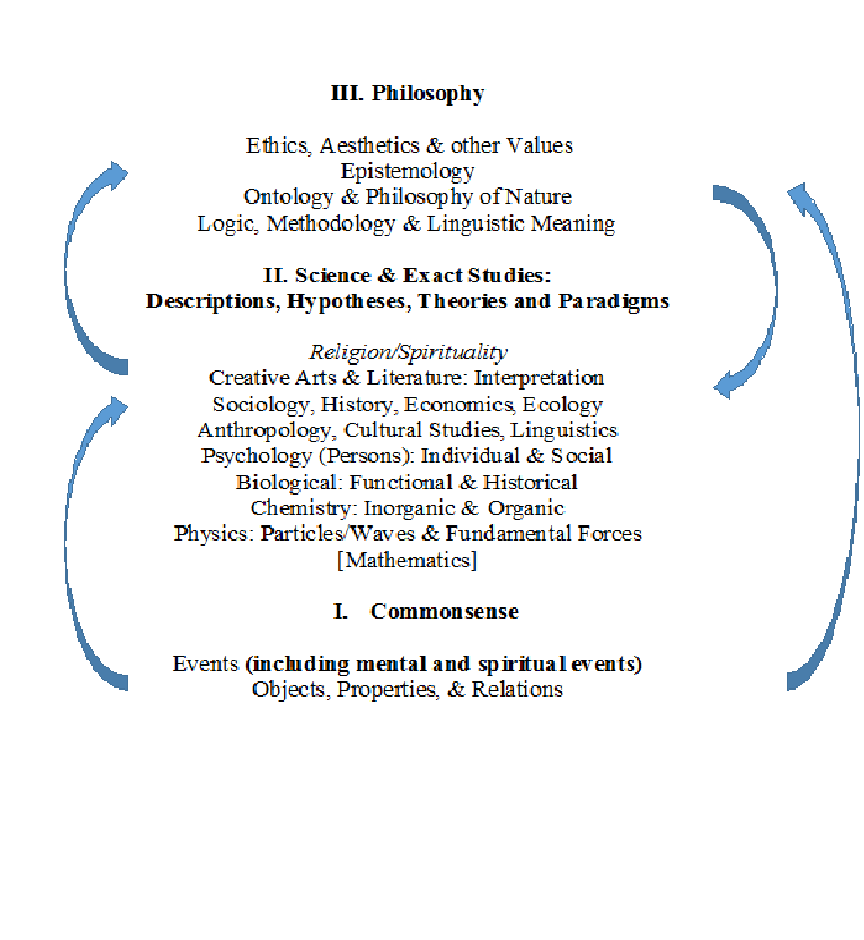
If the sciences are viewed are emerging out of the commonsense conceptual framework, philosophy takes its place as critical commentary on these two domains in an attempt to understand their implications for methodology, ontology, epistemology, meaning, and values. The following diagram pictorially presents the three domains, and includes the familiar hierarchy expected by many physicalists to reflect current or eventual scientific discoveries, viz., Chemistry’s dependence on Physics, Biology’s on Chemistry, etc. (reading Section II from the bottom up).

Wiebe 2


The arrows indicate direction of influence, e.g., philosophy influences science and vice versa, but philosophy has little effect on commonsense. We could put meta-philosophy on the top of the figure as a fourth domain, and also try to include all the subdomains that have evolved as ‘Philosophy of X’, including Philosophy of Religion, but this makes discussion here needless complex. The traditional areas are all profoundly normative (besides being descriptive), which is still beyond satisfactory explanation, I think.

I have placed ‘Religion/Spirituality’ in the hierarchy of social sciences, which is perhaps a controversial move. This field depends upon the concept of person, which is central to all the social sciences, and so exhibits important ties to anthropology, history, sociology, economics, etc. I accord every level in Section II provisional ontological authority, without insisting upon reduction to Physics, unlike Physicalism. Whether reduction is achievable is presently unclear. We would hamper the work of the natural and social sciences if we were to insist on this reduction, so bowing to physicalism’s vision for the future is premature. Meanwhile, if we can get a reduction, why not take it? Here we touch on a delicate matter concerning religion.

Religion has been plausibly described as a descriptive & explanatory domain focused on spirit, which is alleged to be non-physical. I place Religion on the diagram since spirits are construed, at the very least, as beings with minds. Atheism maintains that no minds (in the spiritual sense) exist besides those found in humans (and perhaps some animals). The conflict between atheism and religion is now obvious – it is fundamentally a disagreement at the level of Ontology. Philosophy of Religion exists to engage this question, among others. Physicalism cannot announce its triumph until it has successfully argued that spirit is neither needed nor plausible.

Mental events are instructive in thinking about Philosophy of Religion. As discussion over Philosophy of Mind unfolded in the last century, various strategies were proposed for understanding ‘mental terms’ and the states they were supposed to denote, which include the phenomena described in religious and spiritual experiences (RSEs) as a proper subset. Psychological behaviorists who followed B F Skinner construed such terms as having no place at all in scientific descriptions and explanations of human behaviors, so such mental terms as ‘hoping’, ‘expecting’, and ‘feeling’ were not needed in recording observations. Philosophical behaviorists who followed Rudolf Carnap and Gilbert Ryle interpreted mental terms as denoting human behaviors or (physical) dispositions to act. Still others construed mental terms as having no denotations at all, much as claims about phlogiston have none, since phlogiston does not exist. The eliminativism of Richard Rorty, Paul Feyerabend, and Patricia Churchland gradually gave way to functionalist accounts or to identity theories in which ‘mental talk’ was seen as denoting states or processes that are thoroughly physical in character, to be described, eventually, in neural terms by language that is indisputably public. The identities between mental and neural states are already thought to be corroborated by neural activity detected by MRIs and other novel technology.

If eliminativism had been successful in Philosophy of Mind, RSEs would have quietly disappeared; however, the success of functionalist and identity theories mean that the terms describing RSEs may still be significant for theorizing. The term ‘religion’ is sometimes avoided because of the untoward events associated with religious movements, including ancient Hebrew ethnic cleansing, medieval Christian Crusades, and present-day Muslim jihad, but the term ‘spiritual’ (or ‘spirituality’) is an alternative. Many people now say that they are spiritual, but not religious. If we replace the term ‘religion’ in the phrase ‘Philosophy of Religion’ with the term ‘spirituality’ we get ‘Philosophy of Spirituality’, which has a markedly different connotation than its predecessor. Three observations:

  1. The non-Abrahamic religions have already left their mark on Western culture, and the forms of spirituality that they open up seem more popular than those that Western culture has recognized and celebrated. The general field of spirituality brings into focus several related fields of inquiry requiring critical, but sympathetic, attention. The scope and range of RSEs is yet to be determined, although Sir Alister Hardy made a good start, with his Religious Experience Research initiative now operating out of the Lampeter campus of the University of Wales.
  2. Near-death experience (NDE) has demonstrated that just this one kind of experience, often having spiritual significance, is worthy of close attention. As many as 5% of the US population is said to have experienced a NDE, and the experience is reported in cultures around the world. The significance of NDEs for claims about an after-life, however absurd from a standard empiricist standpoint, is not a trivial matter. Evidence of an obscure form of Reality is in play, suggesting that certain broad religious beliefs – an after-life and the existence of some being (or ‘Being’) concerned with the direction that one has taken one’s life – have an evidential base, which just come into view in the last decades of the 20th
  3. Cognitive science is a new domain of research that purports to be comprehensive in its scope and purview – no mental state, however ordinary or spiritual, will escape its attention, as it tests, in effect, the comprehensive ambitions of physicalism. The comprehensive ambitions of cognitive science means that religious and spiritual experiences (RSEs) will eventually be assessed.

Philosophy of Religion or Spirituality still has a vital place in the modern university, at least until atheism or physicalism triumph.

Travis Dumsday on “What does philosophy of religion offer to the modern university?”

Travis DumsdayTravis Dumsday is Assistant Professor of Philosophy and Religious Studies at Concordia University of Edmonton. We invited him to answer the question “What does philosophy of religion offer to the modern university?” as part of our “Philosophers of Religion on Philosophy of Religion” series.

One word: monks.

That answer may require a bit of unpacking.

To begin, I should note that I’m in agreement with many of the insightful points raised in the blog entries of my colleagues (e.g., Robert Larmer, Diane Proudfoot, and Derek Malone-France), in particular those regarding the critical thinking skills and interdisciplinary abilities fostered by work in philosophy of religion. But I’d like to focus on a point made in an earlier entry (December 22, 2015) by my fellow Albertan, Mark Gardiner (Mount Royal University). As I read him, Gardiner maintains that one of the crucial things philosophy of religion offers to the modern university is an implicit critique of some of the normative assumptions underlying the institution. I’d like to run with this idea, though Gardiner may or may not agree with where I end up.

The ‘modern’ (as opposed to the mediaeval etc.) university, and especially the modern Canadian university, aims largely to supply young people with the credentials needed for their professional advancement and long-term financial well-being. Many jobs that, 60 years ago, required only a high school diploma (if that) today require a 4-year degree. There are a variety of interlocking social and economic causes for this credential-creep, which causes continue to be debated by social scientists.  (There is also a live debate regarding whether credential-creep is, on the whole, a good thing or a bad thing; one worry is that credential-creep has exacerbated economic inequality, insofar as many jobs have been rendered inaccessible to people entirely capable of doing the work but who, for various reasons, are unable or unwilling to complete the 4-year degree now erroneously viewed as its precondition.) At any rate, one of its effects is that for many university students today, the central aim is to acquire a credential, which credential is merely a means to financial security. (Note that I say ‘many’, not ‘most’, and ‘central aim’, not ‘sole aim’.)

Philosophy of religion implicitly places this institutional framework in question, by demanding that its students ask some very deep questions: what, if anything, is the underlying Cause (or causes) of the universe? If there is such a Cause (or causes) what is It (they) like? What, if anything, might It (they) rightly demand of us? What, in light of these facts, do we in turn owe one another? What, if anything, is the proper relationship between our answers to these questions and our modes of life as citizens in a modern polity?

Merely asking such questions raises the prospect of there being a good deal more to life, and to education, than the instrumental end of financial security. (Which is not to say that that end is valueless — merely that it’s instrumental.) This is of course understood already by most students, and would be readily admitted by them once made explicit. But the potential implications are enormous, and perhaps not as readily recognized. For what if there is good reason to think that there is, or even just that there could be, a higher Cause(s) underlying reality as we know it, and to whom we have certain moral obligations — perhaps even an obligation of devotion?

This prospect opens up the further possibility of a mode of life very different from (even contrary to?) that to which the modern university is largely oriented.

The example I am thinking of is traditional Orthodox monasticism, though the reader might supply alternative models. The Orthodox monk (‘monk’ in Orthodox terminology is gender-neutral, referring both to male and female monastics) traditionally lives a life of prayer, study, manual labour, and practical assistance to the poor. It is a mode of life that contributes nothing to the national GDP stats, which fact alone renders monasticism massively counter-cultural. It is a mode of life that, from the perspective of contemporary post-secondary education, probably seems crazy. Yet it can come to seem not only rational but perhaps even appealing – after one has engaged seriously with philosophy of religion. For this is a sub-discipline that inevitably confronts people with the radical possibility of there being a Higher Reality, and the further, even more striking possibility of getting in touch experientially with that Higher Reality.  Monasticism in its turn holds out the prospect of fulfilling that latter possibility by adopting a particular mode of life.

I like formalizing arguments premise/conclusion style:

Premise 1: If an academic sub-discipline is liable to make students ponder monasticism as a rational and appealing life choice, then that academic sub-discipline is massively counter-cultural.

Premise 2: Philosophy of religion is liable to make students ponder monasticism as a rational and appealing life choice.

Conclusion: Therefore philosophy of religion is massively counter-cultural.

The first premise seems true, provided one grants that the overall orientation of the modern university is prepping people for productive participation in a capitalist economy. The second premise may seem less obvious, but if so that’s probably because even those of us working in philosophy of religion tend not to grasp fully the existential implications of the ideas we’re engaged with. If good arguments reveal there is (or even might be) a Higher Reality (or Realities), how can that not push us to devote our lives to getting in touch with It (Them), or at least push us towards admiration of those who do thus devote their lives? What could be more important?

Of course, one’s assessment of the relevant arguments might lead one to conclude that there is no such Reality and that those who thus devote their lives are wasting their time. My point is just that the attempt to answer these questions is a radically counter-cultural activity in the context of the modern university. That’s a good thing, and something distinctive that philosophy of religion can offer the modern university, which claims to welcome critical self-assessment.

Mirela Oliva on “What does philosophy of religion offer to the modern university?”

mirela olivaMirela Oliva is Associate Professor of Philosophy at University of St. Thomas, Houston. We invited her to answer the question “What does philosophy of religion offer to the modern university?” as part of our “Philosophers of Religion on Philosophy of Religion” series.

The modern university is supposed to be a space that facilitates professional training and personal growth. Asking questions about the meaning of life might sound bombastic by the current academic standards, but it nevertheless touches everybody’s mind and heart. Why am I born? Why do I have to die? How can I make my life meaningful? Is there any narrative structure of my life?  Such questions range from metaphysical to ethical and aesthetic aspects of human existence. Philosophy of Religion is well equipped to deal with them precisely because philosophy is, in itself, a discipline structured along these lines. Philosophy can uncover these aspects in religious texts and practices and bring them into deep discussion in a classroom. In fact, philosophy and religion address the meaning of life, and each of them in a peculiar way: the former deploys critical reasoning, the latter relies on apologetic affirmation (sometimes narrative), revelation, and rituals. From the cooperation of philosophy and religion emerges a rich treatment of these issues. Academically, this exchange can take place in several departments (Philosophy, Theology, Religious Studies, Cultural Studies) and programs focused on the Humanities and Social Studies (Liberal Studies, Anthropology).

The success of such endeavor depends, I believe, on the right ethos. To be sure, Philosophy of Religion in a modern university must be inquisitive, critical and rigorous like every other academic discipline. Unlike Theology that defends the beliefs of a certain religion, Philosophy of Religion must be able to open an inter-religious conversation. 1) It is required to question the assumptions and consequences of religious beliefs for a person’s life. 2) It must set up an analysis of symbols and rituals that support those beliefs, relentlessly searching for truth and meaning. 3) It must stand in the middle between theological apology and cultural dissection. 4) Without any prejudice, it must keep a vivid interest in the true knowledge of life and reality.

At the same time, if we really want Philosophy of Religion to make a difference in the modern university, we have to convey passion, enthusiasm and persuasive strength in the classroom. The discussion of the meaning of life cannot be therapeutic, for it cannot directly and openly address the personal situation of each student. But it should be nonetheless inspirational and motivational. Philosophy is quite fortunate to inherit one of the oldest and most appreciated teaching methods, the Socratic method. In conjunction with the intensity, the urgency and the beauty of religious texts, symbols and rituals, such method can prove prolific and uplifting. One cannot talk about the meaning of life without letting oneself be carried, at times, by the high notes of this search: gravity, paradoxical tension, joy of discovery, humor.

We have, therefore, to define our discipline not only in terms of object and method, but also in terms of disposition and style. Philosophy of Religion is called to talk about the meaning of life in a way that helps students to grow as human beings. This is why, I believe, our discipline will be increasingly significant in the modern university.

Robert Smid on “What does philosophy of religion offer to the modern university?”

Robert SmidRobert Smid is Senior Lecturer in Philosophy and Religion at Curry College. We invited him to answer the question “What does philosophy of religion offer to the modern university?” as part of our “Philosophers of Religion on Philosophy of Religion” series.

As several others have pointed out, any answer to this question depends on how the terms in the question are defined.  While the previous series of this blog focused on what “philosophy of religion” is, any answer to the question at hand will so depend on how that prior question is addressed that it is necessary to begin there.  I take philosophy of religion to be that sub-discipline of philosophy that is concerned with the most basic questions pertaining to the study of religion; in other words, it addresses the philosophical questions at the root of religious studies that the latter, as a social science, cannot address for itself.  The most basic of these questions, of course, is “what is religion?” (or, perhaps better, “what is it to be religious”), but it also extends to such related questions as “what counts as religious?” and “who gets to decide?” More developed and specialized versions of these questions include: Is religiosity a characteristic of only some persons, or is it a characteristic of human beings more generally? In what respect are religious truth-claims similar to and different from other kinds of truth-claims? What phenomena not typically considered ‘religious’ might be better understood when examined through the lens of religious studies?  Inevitably, these questions bleed into the discipline of religious studies, but one might just as well say that, pressed back to their root, the questions of religious studies bleed back into philosophy.

Of course, these are not the questions that have historically driven philosophy of religion.  When one can assume Christian normativity—as Western universities often could, at least culturally, prior to the twentieth century—the attention of philosophy to matters of religion can be focused primarily, if not exclusively, on Christian philosophical concerns. These include, but are not limited to, the existence of God, the reality of free will, the explanation of miracles, the possibility of an afterlife, and so on.  Considered outside of such normativity, however, it is unclear why these questions pertain specifically to philosophy of religion: either one is working out these philosophical concerns within the context of a particular religious tradition or set of traditions (in which case it is better understood as philosophical theology), or one is working out such concerns irrespective of their religious implications (in which case it is better understood as philosophy more generally). Thus, for example, arguments concerning the existence of a Judeo-Christian God would count as the former (whether made by theists or atheists), while arguments about the possibility of other planes of existence (such as the “supernatural”) would count as the latter.

To be of appropriate service to a modern university, philosophy of religion should reflect the pluralistic context within which such universities now exist. In this respect, philosophy of religion should be a comparative enterprise, at least insofar as the consideration of any specific religious phenomenon takes place only within the context of a consideration of religious phenomena more generally.  This would help to prevent giving disciplinary preference—explicit or implicit—to the philosophical concerns of one tradition or another.

It is precisely in helping to cultivate this broader perspective that philosophy of religion has the most to offer the modern university. The modern university is many things, and has interests that are both varied and often at odds with one another; however, it includes at least the following: providing a broader and deeper understanding of the world for its students than was possible in secondary school, improving the job prospects for its graduates, supporting the continual development of its disciplines, and contributing to the development of a well-informed and responsible citizenry. By broadening perspectives through the comparative and critical examination of basic assumptions, philosophy of religion—like philosophy more generally—can contribute to each of these interests.  Stated simply, the student who can think critically and creatively about such assumptions is more likely to thrive in a world that struggles to see past its own conventionalities.

Philosophy of religion, however, is in a particularly strong position to make this contribution.  Religious life remains one the dimensions of human life most often rendered immune from critical examination outside of the academy, so a student who learns to think critically about religious subject matter will not only have had to develop particularly strong critical thinking skills but is also likely to be a more culturally sensitive global citizen as a result.  Philosophy of religion thus not only has something of theoretical value to offer to the college, but something of immediately practical value as well.

Ultimately, then, the question of what philosophy of religion has to offer the modern university depends on whether it is able to move beyond the preoccupations of its parochial Christian history and engage the broader array of religious life as such.  While it is important to be aware of this historical trajectory, it would be a mistake to become bound by it.  If philosophy of religion can take this comparative turn, then I think that it has a great deal to offer the modern university.  If it cannot, then it will be difficult to see what it has to offer that philosophic theology or philosophy more generally do not already offer.  The modern university continues to change, as does the religious landscape around it; the value of philosophy of religion will be determined by its ability to adapt to these changes and serve their needs.


Rolf Ahlers on “What does philosophy of religion offer to the modern university?”

rolf ahlersRolf Ahlers is the Reynolds Professor of Philosophy and Religion at Russell Sage College. We invited him to answer the question “What does philosophy of religion offer to the modern university?” as part of our “Philosophers of Religion on Philosophy of Religion” series.

Philosophy of religion lives in the truth and guards skeptically against dogmatic decay of other sciences in the academy. What does that mean?

All thought is contextual. Thought’s objective context of reason is normative, necessary and unitary, while what thought thinks is contingent, for thought always determines what it knows. So we have three: the one context, the many determinants and mediating thought. That insight is basic to all knowing. Enlightening insight looks in and out: internal determination, e.g. self-determination, does not need external input. Similarly, empirical input from the outside also gains specificity and clarity through the modification it experiences in “being elevated into thought” in Hegel’s words. In both cases what is thought about is being changed in being determined. Philosophy of religion is and has always moved on those two planes: From antiquity to the present time we have known that God knows himself as self and other (Plato, Aristotle, John 1:1-5), and that knowledge is philosophy of religion. It has since the beginning claimed to be index sui et falsi, the criterion of itself as true and of what is false, similarly as light enlightens but also casts shadows. Since the very beginning real people like Plato, Plotinus, the Apostles John and Paul, people like you and I but also Pilate, Copernicus, Giordano Bruno, Darwin and Einstein have been part of that broad process of thought’s self-recognition in the history of thought and science, as also in political, economic and scientific history: in that history thought specifies itself as true, thereby also highlighting the false. The language and style of thought operative here has last gained prominence in Hegel; we claim here it has greater validity than for example what is known today as “structuralism”, “narrative philosophy”, “naturalism” and other similar oddities like “philosophy of gender and power studies”, “philosophy of mobbing” – the list of intellectual less rooted movements at modern universities goes on down to the idea that “ours is a post-metaphysical age”, the mother of all superficialities. What and how Darwin or Einstein thought cannot be separated from the ontology of thought thinking itself and what this implies theoretically. But empirical anthropology or sociology or economics or biology gained their potencies through a short-sighted rejection of the objective ontology of thought’s theoretical self-awareness. And that emancipation is, although empowering, reductive. No less reductive in the modern university is the universal acosmism, i.e. worldlessness of what is called “philosophy” or “religion” or other brainy disciplines such as “cybernetics”. Philosophy of religion recognizes and is skeptical of that acosmic reduction of the true heart of the university. The university is not only about providing tools for trade for lawyers or politicians or biochemists or teachers. The university is first and foremost about a disciplinary integrity that could only be achieved through an understanding how all thought coordinates truth and objectivity, and value and factuality, but that coordination is grounded in the distinction between truth and the lie. Distinguishing between truth as truth and the lie as lie gives greater weight to truth than to the lie. This is illustrated in Plato’s paradox of the lie: it is problematic to claim, as does the Cretan, as true that all positions including his own are lies. That means that some positions have more weight than others. The task is then to dislodge the half-truths and the lies in the academic world. Doing so is the skeptical side of philosophy of religion. It seeks to prevent decay into sociological description of religious practices or at the very least preserve a healthy discourse with value neutral sociology of religion, for such description has its place at the university. Also other natural sciences, e.g. Darwin’s insights, are no less central to philosophy of religion as are Einstein’s and that of all other scientists: after all, they are all part of the incredibly creative stream of knowledge’s self-realization in and through them. But there are forms of contemporary science from Marx’ “science of dialectical materialism” to Dawkin’s “science” that reject as “myth” or “delusional” Plato’s, the Bible’s, Spinoza’s and Hegel’s principle that truth is index sui et falsi. With that rejection “science” decays into dogmatism. And any dogmatism must be the object of skeptical critique by truth, for truth identifies the lie as a lie and so this identification points to the skeptical side of truth: Truth is skeptical of the lie and the half-truth. Our universities are populated with far too many dogmatists who claim the ideological mantle of “science” that has decayed to dogmatism. Philosophy of religion’s skeptical rejection of dogmatism throws a skeptical light on the dogmatism of confusing opinions with truth or to declare truth claims are ultimately not provable. Philosophy of religion is skeptical of the peaceful coexistence of all views and all sciences next to each other almost as if the rejection of any theodicy in the science criminology or in holocaust studies is indifferently coequal with Hegel’s philosophy of the spirit which is theodiceic in principle. That means: philosophy of religion would be skeptically watchful over curricular decisions as also over the very institutional structure of the university. In short:  From Plato to Hegel skepticism was central for a philosophy worthy of that name. We claim such centrality of skepticism for philosophy of religion, modifying Luther’s pronouncement: Spiritus sanctus scepticus est: the Holy Spirit is a skeptic. The absence of such skepticism in the modern university has led to world-wide problems from the ecological crisis to economic and demographic and other imbalances on a global scale. To deal with such problems we would first need to recognize the problem in order to then build a real, modern university that overcomes dogmatic reductivism everywhere. That is as much a philosophical as it is a scientific or institutional responsibility: The task is as huge as it is necessary: The specialist in Heidegger needs to learn to talk meaningfully to theoretical physicists as well as to behaviorist economists.